
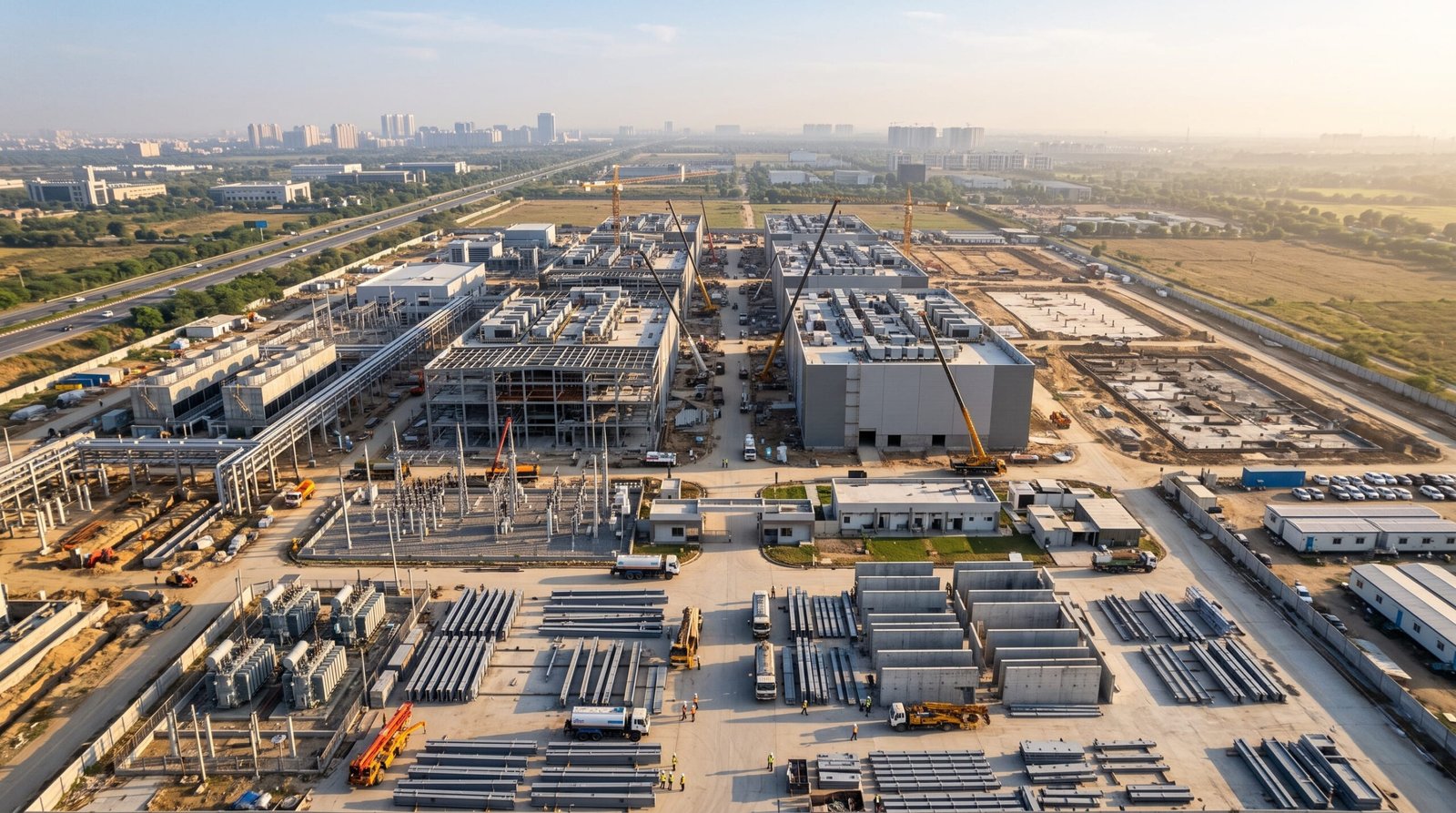
UP data centre policy 2026 was approved by the Uttar Pradesh Cabinet on July 6, 2026, in Lucknow, under the chairmanship of Chief Minister Yogi Adityanath. The policy sets two headline targets: attract more than Rs 2 lakh crore in private investment and add more than 2 gigawatts of new data centre capacity across the state. It replaces the UP Data Centre Policy 2021, which expired in January 2026, and goes significantly further, introducing AI Compute Booster incentives for GPU-based infrastructure, Green and Sustainable Operations incentives for energy-efficient facilities, and special benefits for Tier-3 and Tier-4 data centres targeting districts beyond the Noida-Greater Noida belt.
The scale of what is already in motion makes this more than a policy document. Currently, six data centre parks and two data centre units are operational under the previous policy, while work on a committed capacity of 644 MW is underway. Major companies including Hiranandani Group, NTT Global Data Centers, Adani Group, ST Telemedia, SKVR Software Solution, Web Werks, and Sify Technologies are implementing data centre projects in Uttar Pradesh. Proposals worth nearly Rs 2 lakh crore have already been received from companies including HCL Technologies, Adani Group, NTT Data, Yotta Infrastructure, Sterlite Technologies and Sify Technologies, with MoUs signed for several projects and others moving toward the construction phase.
For enterprise IT teams, CIOs, and infrastructure heads across North India, this policy creates one of the most important infrastructure decisions of the decade. New hyperscale campuses are being built on the Yamuna Expressway, in Greater Noida, and across the NCR corridor. Every one of these campuses represents a destination for enterprise servers, storage systems, and IT infrastructure that currently sits in aging on-premise facilities. The migration window is open right now
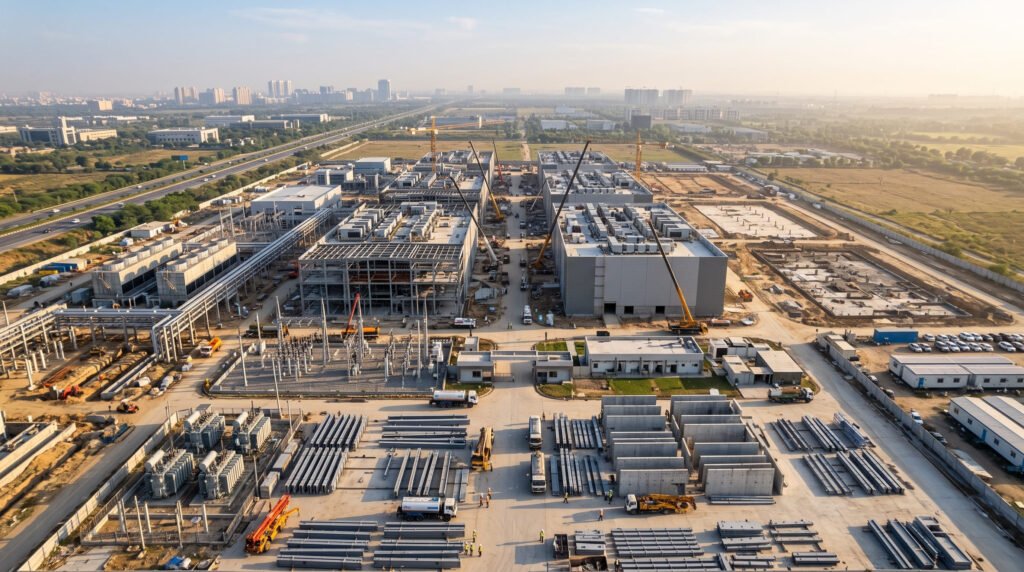
Table of Contents
- UP Data Centre Policy 2026: What the Cabinet Actually Approved
- The Incentive Architecture: What Companies Are Being Offered
- The Noida-Yamuna Expressway Corridor: Where the Action Is
- Who Is Building What: Hiranandani, NTT, Adani, Web Werks, and More
- North India’s Place in India’s $21 Billion Data Centre Market
- What Physical Data Centre Migration Into These Facilities Involves
- What North India Enterprises Must Do Right Now
- How One World Logix Supports Your Data Centre Migration in North India
1. UP Data Centre Policy 2026: What the Cabinet Actually Approved
The Uttar Pradesh Cabinet approved the Data Centre Policy 2026 on July 6, 2026. The policy focuses on AI-ready and green data centres, with emphasis on GPU-based infrastructure, energy efficiency, and sustainable operations. It targets more than 2 gigawatts of additional data centre capacity in the state and investments of over Rs 2 lakh crore. It includes capital subsidies, interest subsidies, concessions on land, stamp duty, electricity charges, and infrastructure support.
A key feature of the 2026 policy is its focus on AI-driven computing infrastructure. The framework introduces incentives for GPU-based data centres and energy-efficient facilities, reflecting the increasing demand for compute resources required for AI model training, inference, and other data-intensive enterprise workloads.
The policy targets generating more than 50,000 employment opportunities and is designed to transform Uttar Pradesh into the country’s largest data centre destination. The government estimates that the policy could generate around 50,000 indirect employment opportunities while encouraging the growth of IT and IT-enabled industries around data centre clusters. Under the previous 2021 policy, seven projects became operational involving investments of approximately Rs 21,343 crore. The 2026 policy is targeting ten times that figure.
2. The Incentive Architecture: What Companies Are Being Offered
The UP data centre policy 2026 incentive structure is designed to compete directly with Maharashtra and Karnataka, which have historically captured the majority of data centre investment.
The policy includes capital subsidies, interest subsidies, concessions on land, stamp duty, and electricity charges, as well as infrastructure support. It also provides special incentives for Tier-3 and Tier-4 data centres, AI Compute Booster incentives, and Green and Sustainable Operations incentives.
IT and Electronics Minister Sunil Sharma stated the policy places special emphasis on GPU-based infrastructure, energy efficiency and sustainable development, with extra incentives proposed for Bundelkhand and Purvanchal regions. This geographic spread is deliberate. The state is trying to move data centre investment beyond the Noida-Greater Noida belt into districts with more available land, lower real estate costs, and untapped power infrastructure.
The single-window clearance system that UP has built since 2021 is a practical differentiator. NTT Global Data Centers’ CEO specifically cited UP’s “good infrastructure, easy land availability, power, and facilities” and the state government’s efficient single-window clearance system when explaining NTT’s decision to expand into Greater Noida beyond its traditional Mumbai, Bengaluru, and Chennai footprint.
3. The Noida-Yamuna Expressway Corridor: Where the Action Is
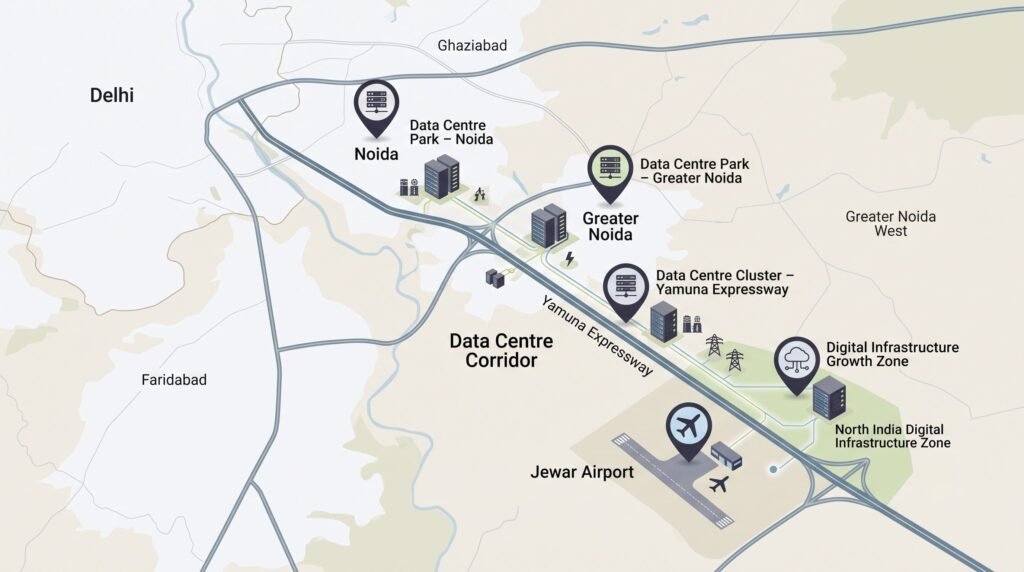
The geographic concentration of UP’s data centre activity tells a clear story. Most investment is clustering along a single corridor: Noida, Greater Noida, and the Yamuna Expressway belt stretching toward the Jewar International Airport site.
These projects span different regions including Noida, Yamuna Expressway Region, Lucknow, Varanasi, Prayagraj, Meerut, and Sitapur. But the primary concentration is the NCR-Yamuna belt. The process of identifying and allocating land in Noida, Greater Noida and the Yamuna Expressway region has already progressed significantly. Land has been allotted to some companies, while land identification and master planning work is underway at other locations.
Sector 28 of the Yamuna Expressway is fast emerging as a business hub because of the upcoming international airport at Jewar. Sify Infinite Spaces and Jackson Ltd. were allocated 5 acres each in Sector 28. Yotta, the Adani Group, and Microsoft have been allocated land for data centres in Noida and Greater Noida. The Jewar airport proximity is a structural advantage for this corridor: it enables air freight of sensitive IT equipment into and out of North India without routing through Mumbai or Delhi’s congested Indira Gandhi International Airport.
4. Who Is Building What: Hiranandani, NTT, Adani, Web Werks, and More
The companies committing to UP’s data centre corridor are not fringe players. They are the same names building in Mumbai, Hyderabad, and Bengaluru.
The Hiranandani Group, NTT Global, Web Werks, Adani Enterprises, and ST Telemedia have together proposed investments exceeding Rs 21,342 crore, with the potential to generate around 10,000 new jobs. Hiranandani built Noida’s first data centre facility on 20 acres of land in Greater Noida’s Knowledge Park 5 under the 2021 policy. Yotta, a subsidiary of the Hiranandani Group, is establishing a massive data centre spanning 3,00,000 sq ft in Greater Noida. NTT is establishing a data centre in Greater Noida, driven by the area’s excellent infrastructure, abundant land availability, and favourable government policies.
Eight data centre parks are planned across the state, spanning Noida to Varanasi, with proposals worth nearly Rs 2 lakh crore received from companies including HCL Technologies, Adani Group, NTT Data, Yotta Infrastructure, Sterlite Technologies, and Sify Technologies. Microsoft’s India Development Centre is expanding with a 6.45 lakh sq ft data centre project in the NCR corridor, with an estimated investment of Rs 1,800 crore.
5. North India’s Place in India’s $21 Billion Data Centre Market
The UP data centre policy 2026 is not being announced into a vacuum. It is arriving at precisely the moment India’s data centre market is entering its most expansive phase.
India’s data centre market, valued at $9.79 billion in 2025, is projected to reach $21.03 billion by 2031, growing at a CAGR of 13.59 percent. As of January 2026, India had 271 operational data centres, with Mumbai, Hyderabad, Delhi-NCR, Bengaluru, and Chennai together accounting for 65 percent of total capacity.
That geographic concentration is what the UP policy is designed to address. UP eyes 9 percent of India’s data centre capacity through its investment pipeline. For context, India’s total existing capacity sits at roughly 1.5 GW. UP is targeting 2 GW of additional capacity, which would, if fully delivered, make it the single largest data centre geography in India within this decade.
The North India demand case is also being driven by AI workload growth. The UP data centre policy’s specific GPU and AI Compute Booster incentives are a direct response to the fact that AI model training and inference require fundamentally different infrastructure from traditional enterprise workloads, higher rack densities, liquid cooling, and power densities that older facilities were not designed to handle.
6. What Physical Data Centre Migration Into These Facilities Involves
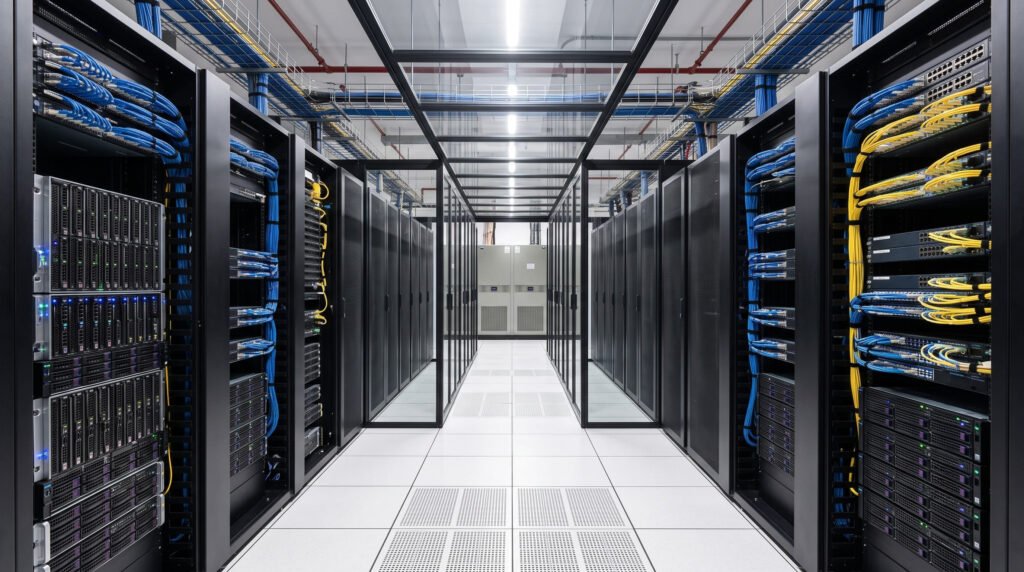
Every new data centre campus built in Noida, Greater Noida, or along the Yamuna Expressway corridor is a destination. And every destination needs a migration.
When an enterprise in Delhi, Gurugram, Noida, or anywhere across North India decides to move its servers, storage, and networking equipment into a modern colocation facility, every piece of that infrastructure needs to be physically decommissioned at the source, transported safely, installed at the new facility, cabled, tested, and brought back online without losing data or causing unplanned downtime.
This is not a task for the internal IT team. A server rack damaged in transit because it was not transported with vibration dampening can cost Rs 3 lakh to Rs 15 lakh in hardware repairs. An extended migration that takes three extra unplanned days costs a financial services or manufacturing company Rs 50,000 to Rs 5 lakh per day in lost productivity. These are not theoretical risks. They are the most common outcomes of migrations handled without a structured, experienced partner.
The specific challenge for North India is that the enterprise IT ecosystem here is large and mature, with significant aging infrastructure sitting in on-premise server rooms that were set up 10 to 15 years ago. That infrastructure is exactly what these new UP data centre parks are designed to absorb.
7. What North India Enterprises Must Do Right Now
The UP data centre policy 2026 has been approved. The land allocations are confirmed. The construction timelines are live. The enterprises that plan their migration now will have the most time, the best colocation rates, and the lowest risk. The ones that wait will be migrating under pressure when campuses go live and demand spikes.
Start with a current-state assessment of your server room or on-premise data centre. How old is your hardware? What is its true total cost of ownership compared to a colocation arrangement in a Tier-3 or Tier-4 certified facility? What would a phased migration look like, moving non-critical workloads first while keeping production systems live?
Colocation providers signing leases for the new UP campuses are doing so 12 to 18 months before facilities go live. If your organisation wants preferred rack positions and enough time to execute a clean, zero-downtime migration, the planning conversation needs to start this quarter.
8. How One World Logix Supports Your Data Centre Migration in North India
One World Logix (OWL), headquartered in CBD Belapur, Navi Mumbai, with operations across Delhi and 30 countries, is India’s Zero-Downtime Migration Specialists for the exact physical data centre migration that the UP data centre policy 2026 is now generating at scale across North India.
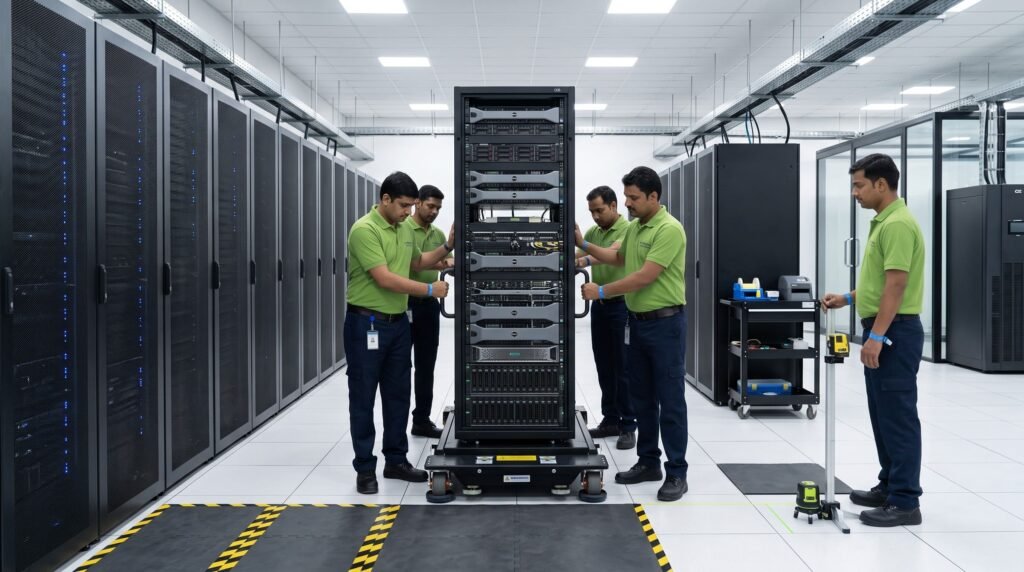
OWL’s data centre migration capability covers the full physical scope: pre-move asset audit and documentation, phased decommissioning planning, vibration-safe server and rack transport, anti-static packing for storage arrays and networking equipment, reinstallation and cabling at the destination facility, and post-migration validation before go-live. OWL holds ISO 9001:2015 certification and is a member of IAM and GEM, the international standards bodies for migration.
As Noida, Greater Noida, and the Yamuna Expressway corridor fill with hyperscale and enterprise-grade data centre capacity, North India’s enterprise IT migration cycle is entering its most active phase. OWL is the migration partner that makes that transition zero-downtime, line-item transparent, and correctly executed from the first rack to the last cable.
Start with a free on-site assessment of your current facility. No commitment, no cost.
Contact One World Logix today:
Phone: +91-882-882-0887
Email: info@oneworldlogix.com
Website: oneworldlogix.com/owl/
Book your free data centre migration assessment. UP’s Rs 2 lakh crore build-out is already in motion. Make sure your enterprise is ready to move into it.