
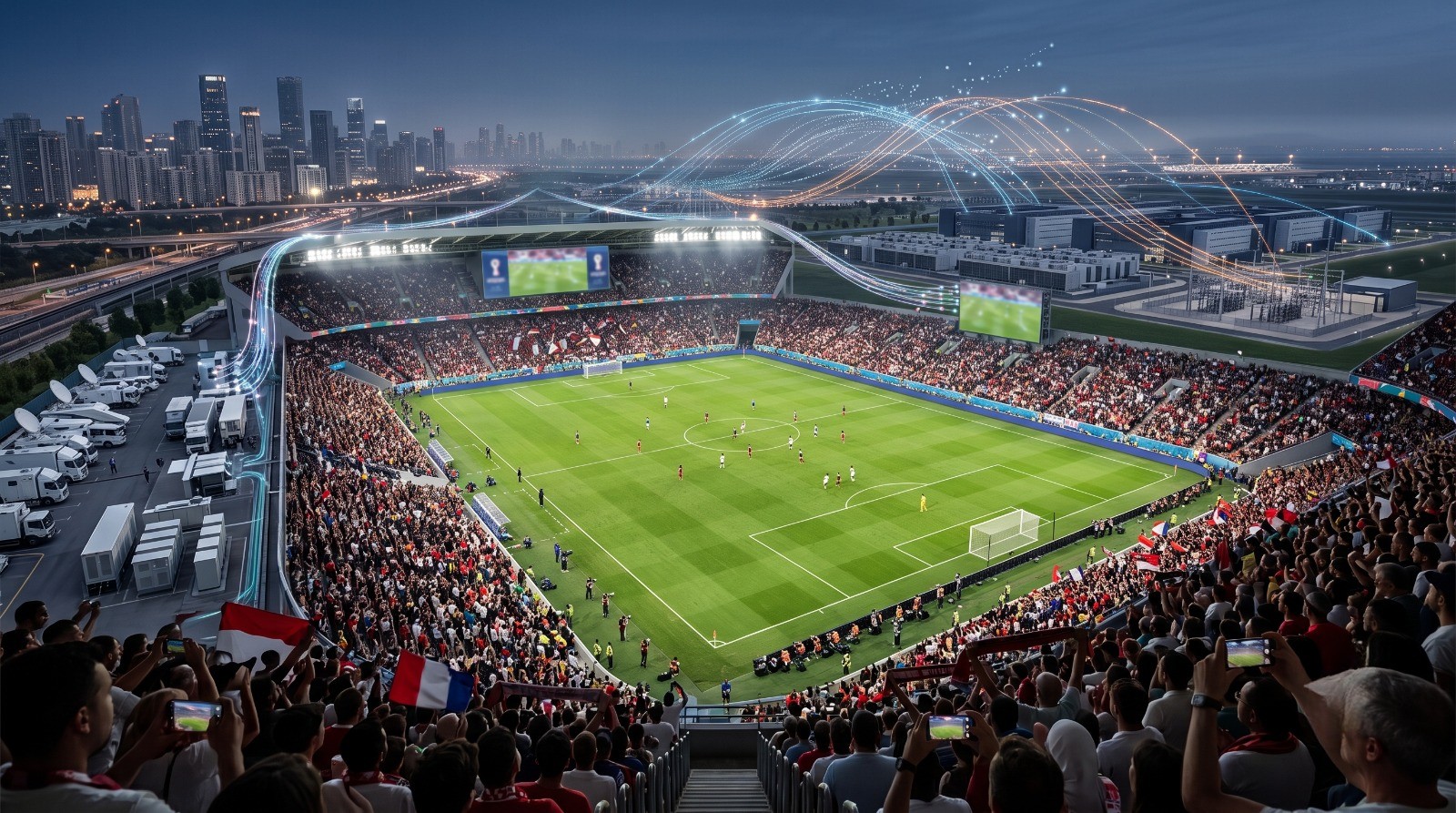
Data center demand 2026 just got its most dramatic stress test ever, and it lasted 39 days. The FIFA World Cup 2026, which ran from June 11 to July 19 across 16 cities in the United States, Canada, and Mexico, was not just the largest football tournament in history. It was, as TES Power managing director Michael Beagan put it directly, “a live, multi-national stress test of digital infrastructure, where the data centres and power systems underneath the tournament were tested as hard as any player on the pitch.”
The numbers behind this stress test are not estimates. They are confirmed figures from named organisations involved in delivering the tournament. One major bank’s research team put total data creation across the tournament at roughly 2 exabytes, counting streaming, broadcast, social platforms, betting, and AI systems together. Fans inside a single stadium consumed more than 50 terabytes of data during a single match. AT&T alone handled 227.6 terabytes of mobile data across nine matches at Dallas. Verizon ran the contribution network at 7 terabits per second, with 600 Gbps allocated per venue across redundant paths. The International Broadcast Centre in Dallas processed feeds from all 16 venues simultaneously, 24 hours a day, across 45,000 square meters of floor space.
And India was watching. FIFA came to Indian screens via Zee5 and Unite8 Sports. But India’s own data point in the streaming story came three months earlier, in March 2026, when JioHotstar recorded 72.5 million digital concurrent viewers during the ICC T20 World Cup final between India and New Zealand, confirmed by ICC CEO Sanjog Gupta, breaking the global record that the same platform had set just three days before. That record, from a single market, on a single platform, tells the same story as the FIFA data. Data center demand is no longer about average load. It is about peak, and that peak is rewriting every capacity planning conversation happening in India right now.
Table of Contents
- Data Center Demand 2026: The FIFA Numbers in Full
- What 2 Exabytes Actually Means for Infrastructure
- The Live Stress Test: Where Data Centers Were Pushed Hardest
- India’s Own Record: 72.5 Million Concurrent Viewers and What It Cost in Infrastructure
- Why This Changes Every Enterprise’s Data Center Strategy
- From Peak Events to Permanent Demand: India’s $36 Billion Trajectory
- What Indian Enterprises Must Do Right Now
- How One World Logix Keeps Your Data Center Migration Zero-Downtime
1. Data Center Demand 2026: The FIFA Numbers in Full
The 2026 FIFA World Cup was the most geographically distributed major sporting event ever staged. 48 teams, 104 matches, 16 host cities across three countries. Every match ran on top of video assistant referees, referee cameras, real-time streaming via 45 cameras per match, 5G private networks, distributed fibre, and AI-driven analytical tools. None of that worked without data centers running without a single second of unplanned interruption.
The International Broadcast Centre in Dallas ran 24 hours a day across 45,000 square meters, processing feeds from all 16 venues simultaneously for 180 broadcast rights holders worldwide. Verizon carried 7 terabits per second across the contribution network, with 600 Gbps per venue via two independent 100 Gbps paths, each with three redundant routes.
The production architecture was fully SMPTE ST 2110 with JPEG XS compression, delivering 5-second latency from stadium to control room, across 9,000 hours of content generated across the tournament, with FIFA expecting 6 billion total engagements. Every one of those engagements passed through a data center at least once. Most passed through several.
2. What 2 Exabytes Actually Means for Infrastructure
Two exabytes is 2 million terabytes. That is the estimated total data creation across the FIFA World Cup 2026, from one bank’s research desk, counting every digital byproduct of the tournament from streaming to betting to broadcast to AI.
Inside a packed stadium, fan data consumption during a single match passed 50 terabytes, a figure the official network sponsor stated directly. AT&T’s network handled 227.6 terabytes of mobile data across nine matches at AT&T Stadium in Dallas alone. To put that in context, 227.6 TB is equivalent to streaming HD video nonstop for nearly 13 years.
The lesson here is not just about football. A World Cup match does not allow demand to spread out over hours or days the way on-demand content does. Demand concentrates just before kickoff, during key plays, at halftime, and in the final minutes. This simultaneity completely alters the required architecture. It is not enough to have capacity for average traffic. You need to absorb very intense bursts without degrading the experience. Every enterprise running mission-critical applications faces the same logic at a smaller scale.
3. The Live Stress Test: Where Data Centers Were Pushed Hardest
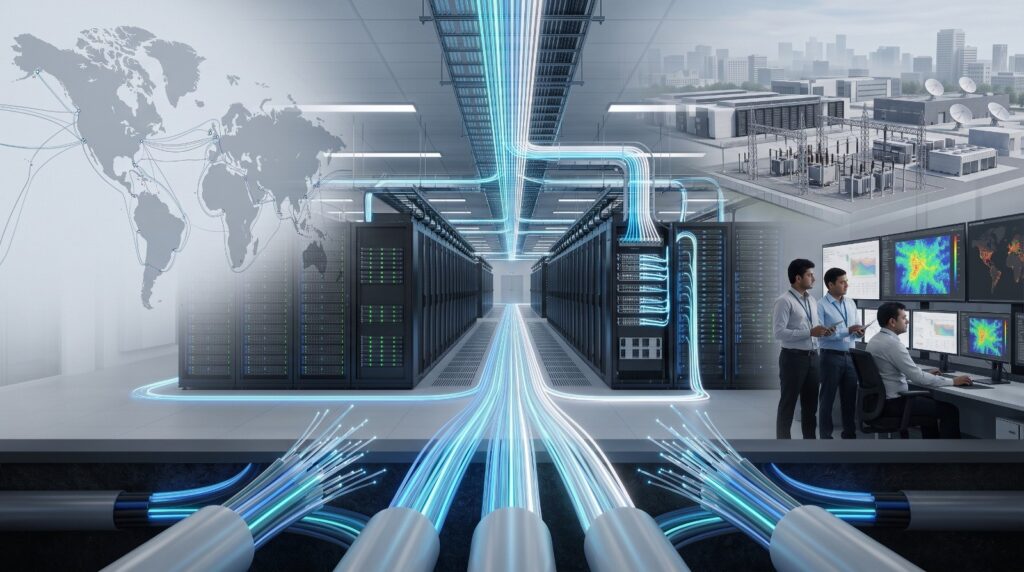
Broadcasters, sponsors, betting platforms, ticketing providers, security teams and billions of streaming fans all depended on data centres running without interruption. A single failure in the power chain could affect live broadcast feeds, digital payments, VAR data, and crowd management systems at the same time.
That exact scenario played out in a minor way during the group stages, when viewers complained about the Netherlands-Japan game coverage being blurry and low quality, with one fan describing it as watching on an old rental television from the 1980s. A data center infrastructure limitation at streaming scale translated directly into user experience degradation within seconds, in front of a global audience.
The 2026 tournament required coordinated capacity across entire host cities, with demand materialising unpredictably as fans moved between venues, fan zones, airports, and city centres. Network slicing was tested at genuine commercial scale for the first time. The lessons from what worked and what did not will carry into every enterprise architecture conversation for the next several years.
4. India’s Own Record: 72.5 Million Concurrent Viewers and What It Cost in Infrastructure
India did not host a single FIFA match. But India’s infrastructure was stress-tested with equal intensity three months earlier, in March 2026, during the ICC T20 World Cup.
The India vs New Zealand T20 World Cup 2026 final broke viewership records, with the ICC confirming 72.5 million digital concurrent viewers at one point during the game. The semi-final between India and England on March 5 generated 619 million views on JioHotstar, making it the most-streamed T20 International match in history. Across linear television and digital platforms, the semi-final delivered a combined reach exceeding 320 million viewers, while watch-time crossed an extraordinary 23 billion minutes.
JioHotstar’s record was driven entirely by audiences within a single market, underlining India’s position as a global leader in live streaming and its ability to handle peak demand while delivering a seamless viewing experience. The infrastructure behind that number included multi-CDN edge delivery across Akamai, Amazon CloudFront, Cloudflare, and Jio’s own CDN, backed by AWS compute, 800 plus microservices, and data centers processing authentication, heartbeat signals, and video delivery simultaneously for tens of millions of users.
This is the demand that is driving India’s data center boom. It is not theoretical. It already happened.

5. Why This Changes Every Enterprise’s Data Center Strategy
The FIFA and cricket streaming stories are not just about media companies. They are about what peak demand means for any enterprise running workloads that cannot tolerate downtime.
A bank processing digital payments during a World Cup final faces the same peak-demand architecture problem as a broadcaster. A logistics platform handling order spikes during a major sporting weekend faces the same burst-capacity question. A pharma company running a clinical data system that must be available 99.99 percent of the time has the same zero-tolerance-for-failure requirement as a live broadcast feed.
The lesson the World Cup taught data center operators is that infrastructure designed for average load fails at peak. The same lesson applies to every enterprise IT team still running aging on-premise infrastructure or colocation arrangements that were sized for 2020 demand levels. Broadcasters used hybrid data-centre and cloud setups to stream the tournament live with lower latency and compliance risks. The hybrid architecture that made FIFA 2026 work is the same architecture that Indian enterprises need to be migrating toward right now
6. From Peak Events to Permanent Demand: India’s $36 Billion Trajectory
The FIFA and cricket records are the visible spikes in a demand curve that is rising permanently. India’s data center market, valued at $10.8 billion in 2026, is projected to reach $36.6 billion by 2035, according to Dimension Market Research.
The investment backing this trajectory is already confirmed. AirTrunk committed $21 billion for a 3 GW campus at Raigad, Maharashtra. Meta and Reliance announced a 168 MW AI data center in Jamnagar. Google has $15 billion planned for Visakhapatnam. Adani and Jabil announced a manufacturing alliance to build AI data center hardware domestically. Yotta is deploying $2 billion with Nvidia Blackwell infrastructure across Navi Mumbai and Greater Noida.
Every hyperscaler building in India is building because demand is real, measurable, and growing faster than existing capacity can absorb. The JioHotstar record was not achieved on legacy infrastructure. It was achieved on three years of continuous infrastructure investment. The enterprises that wait to upgrade their own infrastructure are planning to serve 2030 demand with 2022 architecture.
7. What Indian Enterprises Must Do Right Now
The World Cup stress test revealed one thing clearly: infrastructure that is not built for peak will fail at peak, publicly, visibly, and expensively.
For Indian enterprises, the practical action is a current-state assessment of your data center or server room. How old is your hardware? Is your colocation arrangement sized for where your demand will be in 2027, or where it was in 2023? If you are running aging on-premise infrastructure, what is the real cost of an unplanned outage during your own peak window, whether that is a product launch, a financial quarter close, or a high-traffic sales event?
Enterprises that are planning a migration into modern colocation infrastructure need to start that conversation 12 to 18 months before they want to be live in the new facility. The hyperscale campuses being built now will fill quickly. The companies that plan early get better rates, better rack positions, and enough time to execute the physical migration correctly. The ones that wait get rushed moves and higher risk.
8. How One World Logix Keeps Your Data Center Migration Zero-Downtime
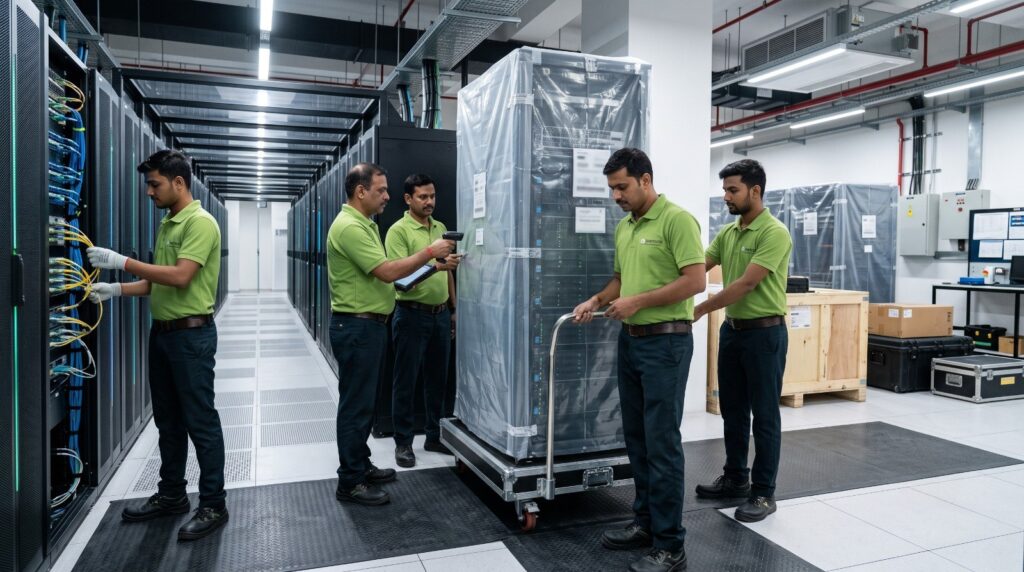
One World Logix (OWL), headquartered in CBD Belapur, Navi Mumbai, is India’s Zero-Downtime Migration Specialists. With 14 years of experience and projects executed across 30 countries, OWL handles the physical side of data center migration that determines whether your move succeeds or fails: full asset audit, phased decommissioning, vibration-safe transport, and validated recommissioning at the destination, all without disrupting your operations.
When a FIFA World Cup runs on 7 terabits per second of redundant network and India sets streaming records with 72.5 million concurrent viewers, the message for every enterprise is the same. Data center demand 2026 is not waiting. The infrastructure that supports it needs to be mission-critical, modern, and correctly migrated.
OWL holds ISO 9001:2015 certification and is a member of IAM and GEM, the international standards bodies for migration. Whether you are moving a single server room into a new colocation facility or executing a full data center relocation across cities, OWL’s team plans every step around your operational hours and SLA commitments, so the business keeps running while the move happens.
Start with a free on-site assessment. No commitment, no cost.
Contact One World Logix today:
Phone: +91-88288 20887
Email: info@oneworldlogix.com
Website: oneworldlogix.com/owl/
Book your free data center migration assessment. The FIFA World Cup just showed the world what peak demand looks like. Make sure your infrastructure is ready for yours.