
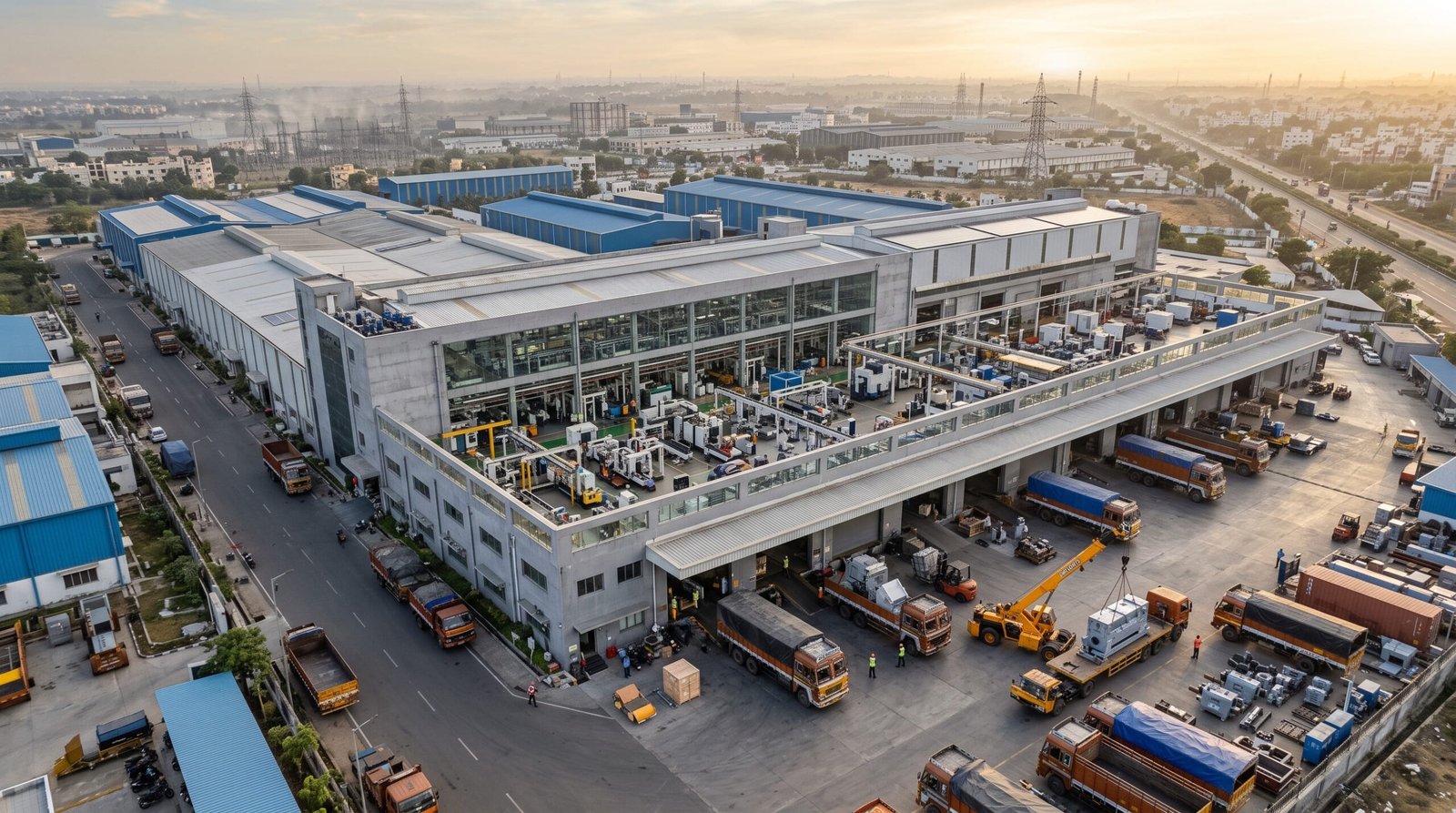
Production line relocation India 2026 is no longer a rare event happening once in a decade. It is happening every week, across every major industrial sector, driven by forces that show no signs of slowing down.
Globally, Toyota is consolidating Corolla production from its Indaiatuba plant to Sorocaba in Brazil as part of an R$11 billion manufacturing restructure. ZF Friedrichshafen, Hanon Systems, Dacia, and Faurecia are all relocating production lines at a pace the logistics industry has not seen before. The global manufacturing landscape is entering a new era. Rising costs, geopolitical tensions, and supply chain disruptions are pushing companies to diversify production beyond China, with India, Vietnam, Mexico, and Indonesia rapidly becoming key manufacturing hubs.
India sits at the center of this wave. New production lines are arriving from China under the Plus One strategy. State Pollution Control Boards are ordering factories out of residential zones into industrial areas. Land costs in Tier-1 cities are forcing manufacturers to relocate to Tier-2 locations. And the industrial equipment shifting market is growing at 8 to 10% CAGR, driven by manufacturing, power, and construction sectors.
This blog covers everything operations heads, plant managers, and factory owners need to know about executing a production line relocation in India in 2026 — without losing a single day of production they did not plan to lose.
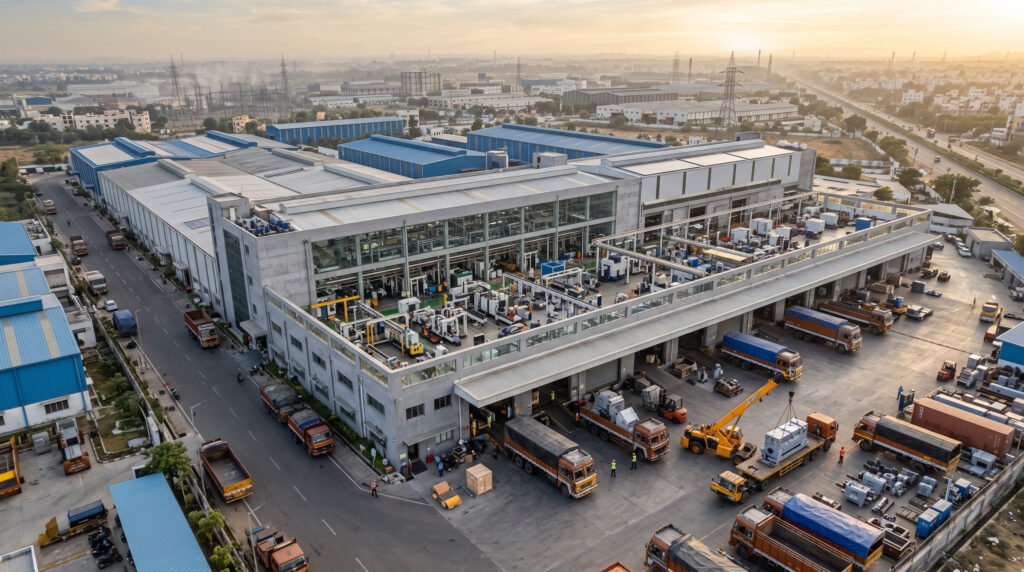
Table of Contents
- Production Line Relocation India 2026: Why the Wave Is Accelerating
- What Makes Production Line Relocation Different from Standard Machine Shifting
- The Global Shift Wave: What Toyota, ZF and Others Are Actually Doing
- India-Specific Drivers: China Plus One, SPCB Orders and Land Costs
- The Real Cost of Getting Production Line Relocation Wrong
- How to Execute a Zero-Downtime Production Line Relocation
- How One World Logix Handles Production Line Relocation India 2026
1. Production Line Relocation India 2026: Why the Wave Is Accelerating
Three forces are converging in 2026 to make production line relocation the most urgent operational challenge in Indian manufacturing.
China Plus One is not a temporary trend. It is a long-term structural shift. Manufacturing FDI into India grew 18% year-on-year to USD 19.04 billion in FY 2024-25. Apple’s iPhone exports from India crossed INR 2 trillion in calendar 2025, an 85% jump from 2024. India’s share of global iPhone production reached approximately 25% in 2025. Every new production line arriving from China or being set up fresh in India under PLI incentives requires professional installation, alignment, and commissioning.
China’s April 2026 State Council decrees restricting supply chain diversification add new costs and complications for global firms seeking to reduce their Chinese exposure, potentially creating urgency for companies that have been delaying their India manufacturing bets.
Simultaneously, State Pollution Control Boards across Maharashtra, Gujarat, Tamil Nadu, and Telangana are issuing relocation orders to factories operating in areas now classified as residential or mixed-use zones. These factories have 6 to 18 months to move. Their production lines must relocate whether the market is favorable or not.
And land costs in industrial belts around Mumbai, Pune, Chennai, and Bangalore have made expansion on existing sites economically impossible for many manufacturers. The alternative is relocation to lower-cost Tier-2 industrial zones — with everything that moving a production line involves.
2. What Makes Production Line Relocation Different from Standard Machine Shifting
This distinction matters enormously, and most factory owners only understand it after they have experienced a poorly executed production line move.
Moving a single CNC machine or press is a contained, defined task. Moving a production line is a systems project.
A production line has interdependencies. Machines share utilities — compressed air, cooling water, nitrogen, electrical bus bars. They are connected by conveyors, part transfer systems, and automated buffer zones. They run in a specific sequence where the output of Machine A becomes the input of Machine B. You cannot move Machine B without understanding exactly how it connects to A and C.
A production line has precision relationships. After relocation, every machine must be re-leveled and re-aligned not just individually but relative to every other machine in the line. A conveyor that is 2mm out of level across 20 meters will jam consistently. A welding robot that is 0.5 degrees out of position will produce defective welds.
A production line has a commissioning sequence. You cannot power everything up simultaneously. There is a specific sequence for bringing utilities live, commissioning individual machines, running the line dry, then running with product. Skipping steps in this sequence causes problems that take days to diagnose.
Relocation remains a difficult process for many businesses. Many companies don’t have the money to absorb unexpected delays. Legal and operational challenges also make expansion more complicated than anticipated. The day rate of a halted production line is the number that converts theoretical risk into real money. For an automotive component line running 500 units per shift at Rs 2,000 per unit, every unplanned production day costs Rs 20 lakh. For a pharmaceutical packaging line or a food processing line, the figure is often higher.
3. The Global Shift Wave: What Toyota, ZF and Others Are Actually Doing
The global production line relocation wave of 2026 is worth understanding because it is setting the benchmark for how professional industrial relocations are executed.
Toyota’s decision to consolidate Corolla production from its Indaiatuba plant to its Sorocaba facility in Brazil is part of an R$11 billion manufacturing restructure. This is not a simple machine shift. Entire stamping lines, body welding cells, paint booth systems, and final assembly lines are being relocated and recommissioned. Toyota’s timeline is measured in months, not weeks, and their downtime budget is measured in days, not weeks.
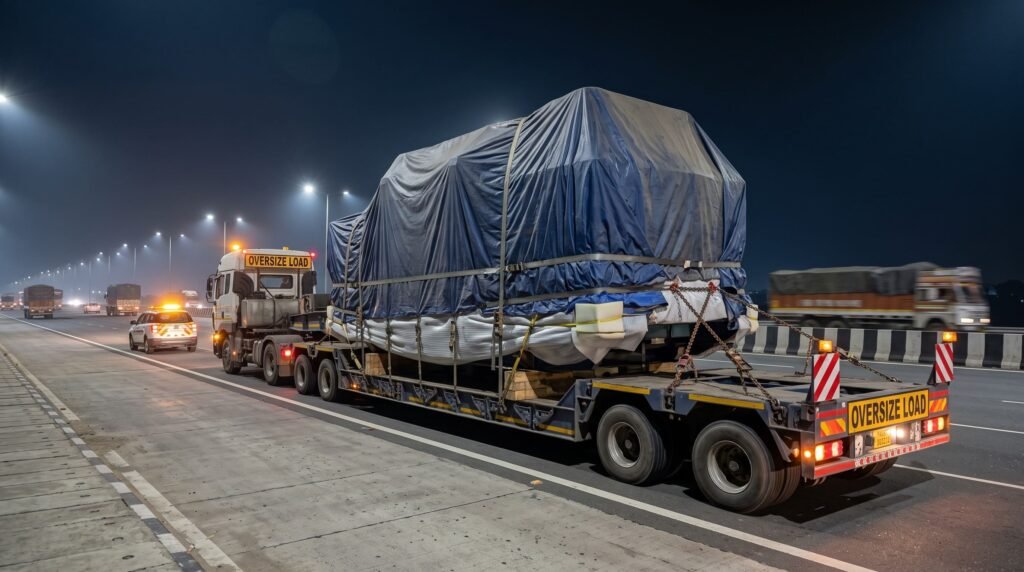
ZF Friedrichshafen, one of the world’s largest automotive suppliers, is relocating production lines across multiple countries as part of its global manufacturing footprint rationalization. Their relocations involve 30 to 45 ton components requiring flat rack transport, specialized customs documentation, and precision reassembly at the destination.
Hanon Systems, Dacia, and Faurecia are executing similar programs. What all of these global manufacturers have in common is that they are using specialist industrial relocation partners — not general logistics companies — for the physical execution.
The reason is straightforward. These companies have calculated the cost of downtime against the cost of a specialist, and the specialist always wins. A general mover who saves Rs 5 lakh on a relocation quote but causes three extra days of unplanned downtime has cost the manufacturer Rs 60 lakh. The math is not complicated.
4. India-Specific Drivers: China Plus One, SPCB Orders and Land Costs
For Indian manufacturers specifically, 2026 has three distinct triggers pushing production line relocation to the top of the operational agenda.
China Plus One inflows. New production lines arriving in India from Chinese or other international locations need to be installed, aligned, and commissioned at greenfield or brownfield Indian sites. This is machine erection work — not relocation in the traditional sense — but it requires the same specialist capability. India operates several dedicated industrial corridors connecting major cities and ports. The government has established 12 major industrial corridors across the country, and special provisions exist for companies relocating from China, including fast-tracked approvals and dedicated support teams.
SPCB relocation orders. State Pollution Control Boards in Maharashtra, Gujarat, and Tamil Nadu are issuing orders requiring factories in residential and mixed-use zones to relocate to designated industrial areas. These orders carry legal deadlines. Manufacturers who miss them face production stoppages imposed by authorities rather than planned by management. The urgency created by SPCB orders compresses the planning timeline and increases the execution risk.
Tier-1 to Tier-2 migration. Industrial land in Mumbai, Pune, Chennai, and Bangalore has become too expensive for manufacturing expansion. The MIDC zones in Pune’s periphery, the TIDCO zones in Tamil Nadu’s secondary cities, and the GIDC zones in Gujarat’s Tier-2 towns are absorbing manufacturing capacity that can no longer fit in Tier-1 locations. Each of these moves involves a production line relocation.
5. The Real Cost of Getting Production Line Relocation Wrong
The most expensive production line relocations in India are not the ones that cost the most to execute professionally. They are the ones that were executed cheaply and went wrong.
Downtime overrun. A production line relocation planned for 10 days that takes 25 days due to poor sequencing, misaligned equipment, and utility reconnection errors does not just cost the day rate for 15 extra days. It costs customer penalties for missed delivery commitments, overtime pay for the team trying to recover, and management time that was not in the budget.
Equipment damage during transport. A 30-ton transfer press that is improperly secured on a flat rack trailer and arrives with cracked bed casting has a repair bill of Rs 25 lakh to Rs 80 lakh, a delivery lead time of 8 to 16 weeks for the casting, and a downtime cost for every day the line cannot run. The transport saving from using a general freight carrier instead of a specialist industrial mover is typically Rs 1 to 3 lakh. The damage cost is 20 to 50 times that figure.
Alignment errors at commissioning. A production line that is mechanically reconnected but geometrically misaligned will produce scrap from day one. Discovering this after the first production run means stopping the line again, calling in the OEM service team, and losing another week. The cost of proper precision alignment at commissioning is a fraction of the cost of discovering the problem in production.
Documentation gaps. For ISO-certified manufacturers and automotive Tier-1 suppliers, every machine relocation requires documented evidence of the process — machine condition before and after, calibration records, utility reconnection sign-offs. Moving without documentation creates audit findings that can trigger customer quality investigations. Professional relocation partners provide this documentation as standard.
6. How to Execute a Zero-Downtime Production Line Relocation
Zero downtime does not mean the line never stops. It means every minute of stoppage is planned, budgeted, and within the agreed window. Here is how professional production line relocations are structured.
Phase 1: Line Mapping and Dependency Documentation. Before anything is disconnected, every machine is documented — its physical position, all utility connections, all mechanical interfaces with adjacent equipment, calibration parameters, and current production settings. This is the map you reassemble from. Without it, reassembly is guesswork.
Phase 2: Destination Preparation. The new site must be ready before the first machine arrives. Foundation specifications, anchor bolt positions, utility stub-outs, electrical panel locations, compressed air header positions — all of this must be installed and verified before the first truck arrives. The most common cause of extended downtime in production line relocations is equipment waiting at the destination site while civil and utility work finishes.
Phase 3: Sequenced Dismantling. The line is dismantled in reverse commissioning order. The last machine installed is the first machine removed. Utilities are isolated, purged, and capped in the correct sequence. Each machine is tagged, photographed, and prepared for transport individually.
Phase 4: Specialized Transport. Heavy components — transfer presses, large injection moulding machines, furnace sections — require low-bed trailers, hydraulic axle trailers for very heavy pieces, and in some cases cranes for loading and unloading. Oversize load permits for machines exceeding standard road dimensions must be obtained in advance. For interstate moves, this process takes 7 to 14 days to arrange.
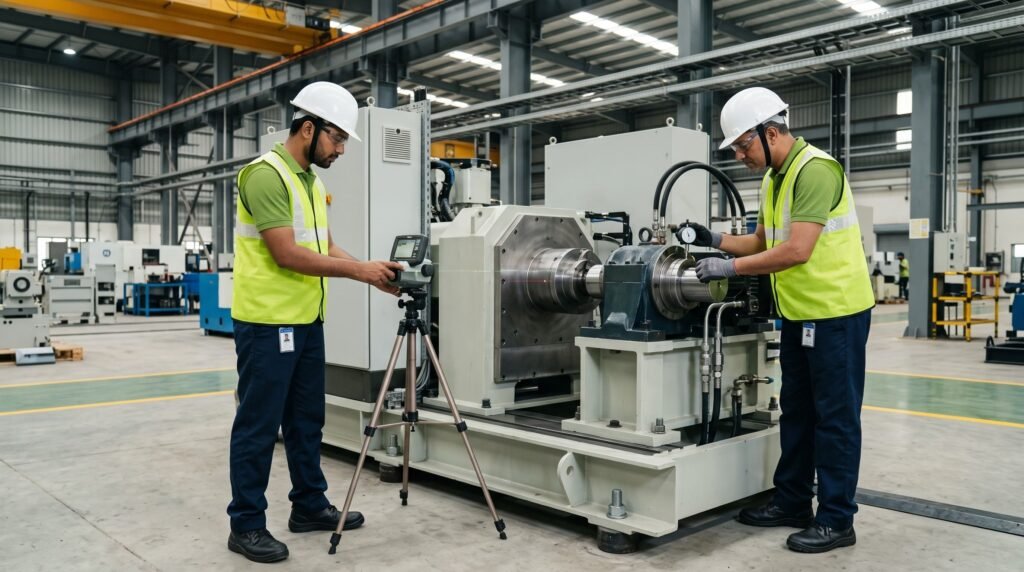
Phase 5: Recommissioning in Sequence. Equipment is installed in commissioning order, utilities are connected progressively, and each machine is individually powered up and validated before the next is connected. The line is then run dry — no product — to validate the mechanical sequence. Only after the dry run is approved does production start.
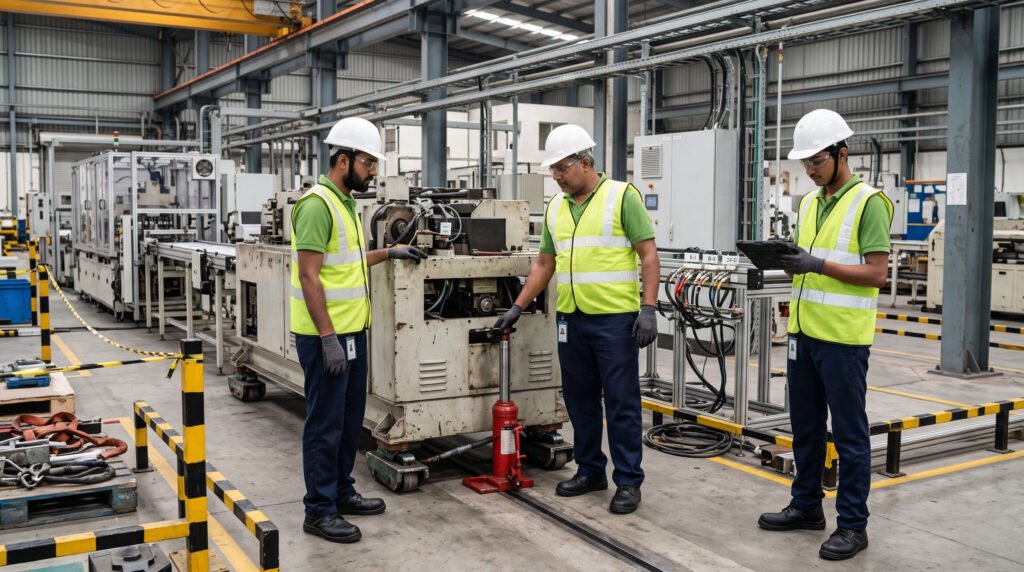
7. How One World Logix Handles Production Line Relocation India 2026
One World Logix is India’s specialist for production line relocation — not a general mover that handles industrial equipment as one of many services, but a company built specifically around the engineering and logistics requirements of complex industrial moves.
Our approach to production line relocation India 2026 is built on four capabilities that most logistics companies cannot match.
In-house mechanical and electrical engineers. The same engineers who assess your line plan the dismantling sequence, supervise the disconnection, manage the transport, and execute the recommissioning. There are no handoffs between an assessment team, a logistics team, and an installation team. One team, one accountability, from first site visit to final production sign-off.
Specialized equipment owned, not rented. Hydraulic jacks, skates, gantry systems, anti-vibration crating, low-bed transport vehicles — we own these assets and operate them with our trained staff. When your project needs equipment, it is available and maintained to our standard.
Precision recommissioning capability. We do not define project completion as equipment delivered. We define it as the line running at its pre-move production rate, with documented calibration records and a signed engineering handover. For automotive Tier-1 suppliers, pharma companies, and food processors where post-move validation is a quality requirement, this is not optional — and we treat it that way for every client.
Cross-sector experience. We have executed production line relocations in automotive, pharma, food and beverage, plastic, FMCG, battery and renewable energy, and cement sectors. The engineering challenges are different in each. Knowing the difference between how a pharmaceutical packaging line must be handled compared to an automotive welding cell is not something you learn from a manual.
For production lines arriving in India from international locations as part of China Plus One investments, our Global Field Engineer network in 30+ countries means we can coordinate the overseas dismantling, packing, and export documentation, handle Indian customs clearance, and execute the Indian installation — under one project manager.
📞 +91-882-882-0887
📧 info@oneworldlogix.com
🌐 oneworldlogix.com/owl/machine-shifting/
Get a free site assessment for your production line relocation today.
A successful production line move is only part of the picture. Once machinery reaches its destination, our team also handles the supporting IT and data infrastructure — including structured cabling services for the new facility and smart hands and remote hands services for ongoing on-site support. This means your production and IT systems are relocated, connected, and running under one accountable partner.