
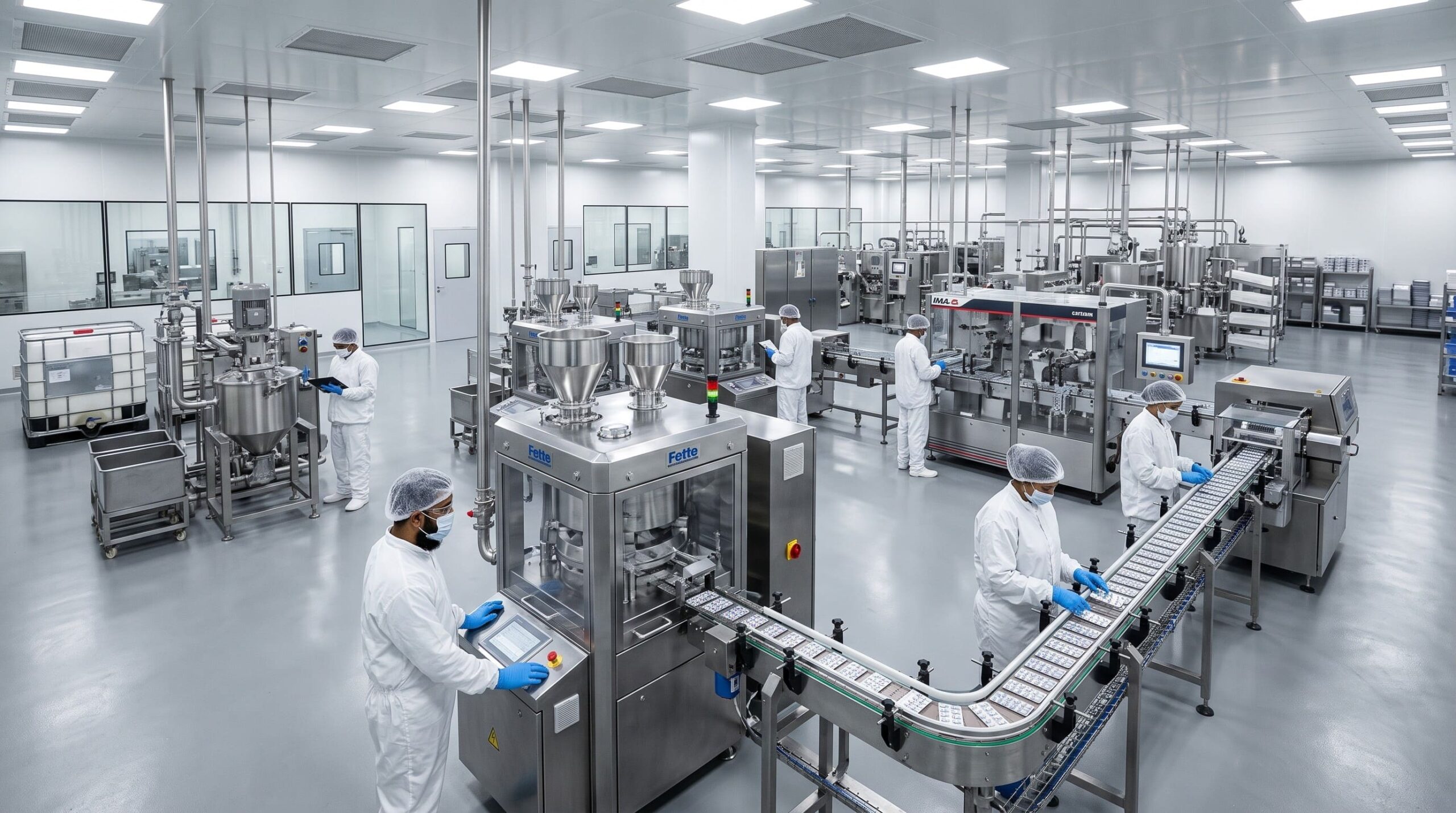
Pharma plant relocation just moved from a strategic option to an operational deadline for Indian pharmaceutical companies. On July 21, 2026, two days before this blog was written, President Donald Trump announced that generic drug manufacturers have two years to move production to the United States or face a 100 percent import duty from August 2028. That levy will then double to 200 percent in August 2029.
This announcement came on top of what was already in motion. On April 2, 2026, a Section 232 tariff of 100 percent on patented pharmaceuticals and their APIs became binding law. For large companies, this is effective from July 31, 2026. For the 17 named companies in Annex IV, the deadline is September 29, 2026. India was given no preferential tier and falls under the default 100 percent rate by not appearing in any of the reduced-rate groupings.
The numbers at stake are significant. India exported $9.7 billion worth of pharmaceutical products to the United States in FY2024-25, accounting for 38 percent of India’s total global pharma exports and close to 10 percent of all merchandise exports to the US. Indian companies supply 47 percent of all generic prescriptions dispensed in the US. This is not a peripheral trade relationship being disrupted. It is the core of India’s most internationally successful industry, and the tariff clock is now running.
Table of Contents
- Pharma Plant Relocation: The Tariff Structure Every Plant Head Must Know
- What the Generics Deadline Actually Means: 0%, 100%, 200%
- Which Indian Companies Are Already Moving and What They Are Doing
- The Escape Routes: Onshoring Plans, MFN Deals, and Reduced Rates
- What a Pharma Plant Relocation Actually Involves Physically
- Cost and Timeline: What a Machinery Move From India to US Really Costs
- What Indian Pharma Companies Must Do in the Next 24 Months
- How One World Logix Supports Pharma Plant Relocation Projects
1. Pharma Plant Relocation: The Tariff Structure Every Plant Head Must Know
On April 2, 2026, President Trump issued a proclamation imposing a 100 percent Section 232 tariff on imports of patented pharmaceutical products and their associated active pharmaceutical ingredients, effective July 31, 2026 for large companies and September 29, 2026 for smaller manufacturers.
The rate structure is tiered and company-specific, not just country-specific. Products from Japan, EU member states, South Korea, Switzerland, and Liechtenstein are subject to a 15 percent rate. The United Kingdom is subject to a 10 percent rate. India, China, and most other countries receive the default 100 percent rate by not being listed in any preferential tier.
Companies with onshoring plans approved by the Secretary of Commerce will be subject to a reduced rate of 20 percent additional tariff on top of their applicable base rate, until April 2, 2030. Companies that also enter into an MFN pharmaceutical pricing agreement with the US Department of Health and Human Services will be subject to a 0 percent Section 232 tariff, effective September 29, 2026, through January 20, 2029. For Indian companies, the path to zero tariff runs directly through a US manufacturing commitment.
2. What the Generics Deadline Actually Means: 0%, 100%, 200%
Until two days ago, Indian generic exporters had a temporary shield. Generic pharmaceuticals, biosimilars, and certain specialty products including orphan drugs remain exempt from the Section 232 tariff for now, with a formal review of generics mandated within one year.
That review is now effectively over before it began. On July 21, 2026, Trump announced that generic drug manufacturers will have two years to move production to the US or face a 100 percent import duty from August 2028, with that levy doubling to 200 percent in August 2029.
India has the most at stake among generic drug exporters. It exported $25.8 billion in pharmaceuticals globally in 2025, of which $9.7 billion, or 37.7 percent, went to the US, making America India’s largest pharmaceutical export market. Indian companies supply 47 percent of all generic prescriptions dispensed in the US.
The 24-month window is not a concession. It is a structured deadline with an escalating penalty. The bigger question for investors and plant heads is whether companies can reduce their dependence on exporting low-cost generic medicines from India before the tariff comes into effect, since generic medicines will continue to attract a 0 percent tariff until July 31, 2028. Two years to relocate or restructure production is a tight window for an industry that runs on regulatory approvals, FDA facility certifications, and complex supply chains.
3. Which Indian Companies Are Already Moving and What They Are Doing
The tariff announcement did not catch every Indian pharma company off guard. Several had already begun building US manufacturing positions.
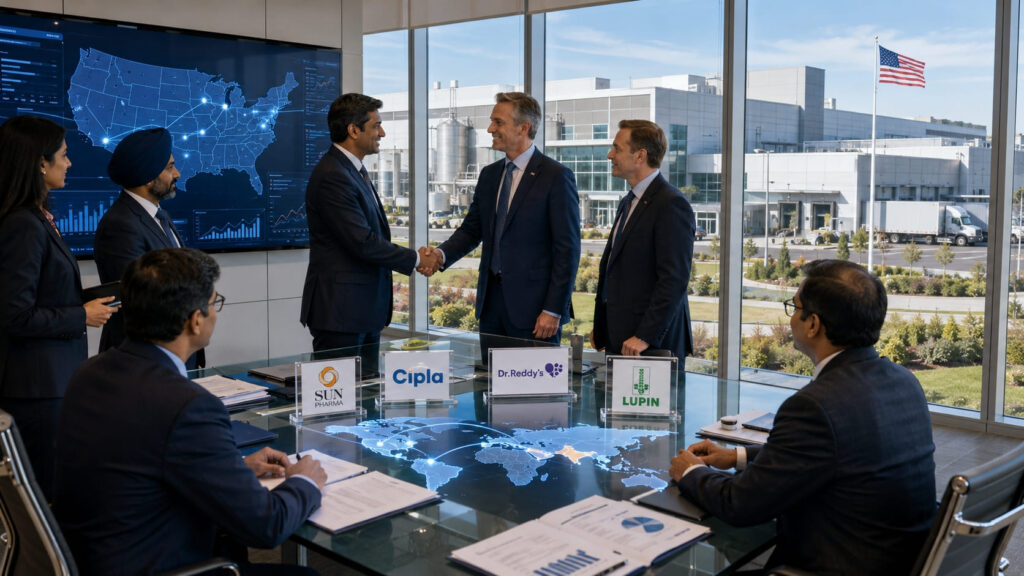
Sun Pharma, Zydus Lifesciences, Lupin, Aurobindo Pharma, Cipla, and Dr. Reddy’s Laboratories already operate FDA-approved manufacturing facilities in the United States. Cipla is expanding production at plants in Massachusetts and New York. Dr. Reddy’s Laboratories has said it is willing to increase US manufacturing if it makes commercial sense. Sun Pharma announced its intention to set up manufacturing plants in the US through its $11.75 billion acquisition of New Jersey-based Organon and Co.
Other Indian companies including Aurobindo Pharma, Biocon Group, Glenmark Pharmaceuticals, Granules India, Jubilant Group, Lupin, Piramal Pharma, and Zydus Lifesciences have all announced plans to invest in the US.
These are the companies with the resources to execute. For mid-sized Indian generic manufacturers without existing US facilities, the 24-month window is the most compressed and consequential business decision they have faced.
4. The Escape Routes: Onshoring Plans, MFN Deals, and Reduced Rates
The tariff structure provides three functional paths for Indian pharma companies, and choosing the right one depends on company size, US revenue exposure, and manufacturing capability.
The first path is an approved onshoring plan. A company that submits and receives Commerce Department approval for a US manufacturing investment plan gets a reduced 20 percent Section 232 tariff instead of 100 percent, giving it runway until April 2, 2030, to complete the relocation. This is the most accessible path for mid-sized manufacturers who cannot immediately execute a full production move.
The second path is an MFN pricing agreement. Companies that sign both a Commerce onshoring plan and an HHS MFN pricing agreement get a 0 percent tariff rate through January 2029. Under Trump’s most favored nation policy, major pharmaceutical companies including Eli Lilly, Pfizer, and Novo Nordisk have already struck deals to lower drug prices and receive tariff exemptions for three years. For large Indian companies with significant branded or specialty portfolios, this path is worth evaluating seriously.
The third path is the hardest: wait, absorb the tariff, and rely on cost advantage. GTRI analysis notes that many Indian generic medicines sell for seven to ten times less than branded alternatives. Even after a 100 percent tariff, many products could remain cheaper than branded medicines, meaning much of the additional cost would likely be passed on to US healthcare providers, insurers, and patients. But this path carries significant market share risk as US domestic production scales up.
5. What a Pharma Plant Relocation Actually Involves Physically
This is the section most tariff analysis articles skip entirely. The policy decision to relocate a pharma plant is one conversation. The physical execution is a completely different and significantly more complex one.
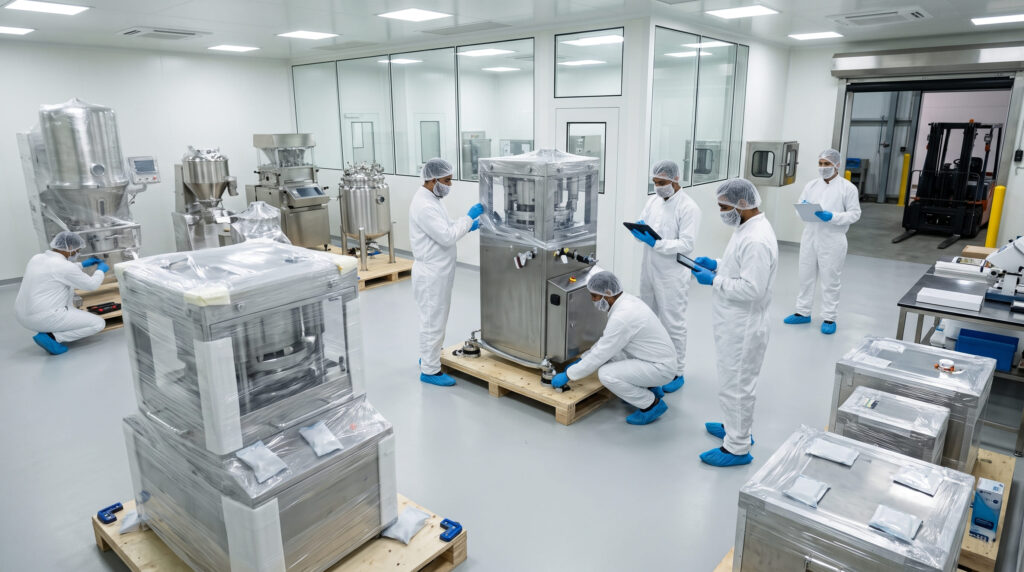
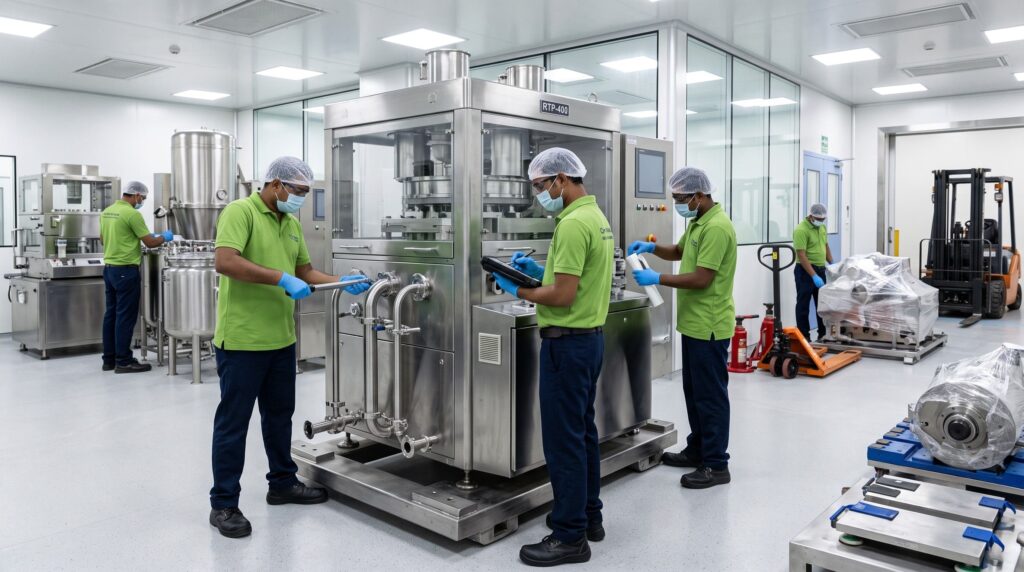
A pharmaceutical production facility contains equipment categories that do not exist in most other manufacturing environments. Tablet presses, granulators, fluid bed dryers, coating machines, filling and packaging lines, cleanroom HVAC systems, validated water systems, and API synthesis equipment all require specific handling, packing, transport, and recommissioning protocols that go well beyond standard industrial machinery moving.
Contamination control is a non-negotiable layer on top of standard machine shifting requirements. Every piece of equipment that moves must be documented, cleaned, sealed, and validated at the destination before it can be used in production. The FDA has specific requirements for equipment relocation documentation, and any gap in that paper trail can trigger a validation failure that delays production restart by weeks or months.
Cleanroom infrastructure does not move at all. It is built at the destination. But every piece of production equipment inside it does move, in a specific sequence, with specific packaging standards, and with a recommissioning process that must be completed and documented before a single batch can be manufactured.
International pharma plant relocation, from India to the US in this context, adds customs clearance, FDA prior notification for drug-manufacturing equipment, shipping documentation aligned with 21 CFR Part 210/211 requirements, and import compliance at the US port of entry. This is not a job for a general freight forwarder.
6. Cost and Timeline: What a Machinery Move From India to US Really Costs
For plant heads and CFOs building business cases right now, here are real cost benchmarks for pharma equipment relocation at different scales.
A single production line relocation covering 5 to 15 pharmaceutical machines, assessment, planning, cleanroom packing, documentation, and recommissioning support, typically runs Rs 8 lakh to Rs 40 lakh for the India-side execution. International freight via ocean adds 60 to 150 percent over domestic equivalent depending on equipment weight and volume. Air freight, which is 3 to 5 times more expensive than ocean, is used for time-critical components only.
A medium pharma plant relocation covering 40 to 100 machines runs Rs 60 lakh to Rs 2 crore for full turnkey execution, over 2 to 5 months, before international freight is added. Large plant relocations above 100 machines are quoted after a full site assessment but typically run Rs 1.5 crore to Rs 8 crore and above, with timelines of 3 to 8 months.
The single most expensive mistake in pharma plant relocation is starting late. A company that begins its onshoring plan application in Q1 2027 and then tries to physically relocate production lines in the 6 months before the August 2028 deadline will face compressed timelines, premium freight costs, and a higher risk of FDA validation delays. The companies that begin site assessments and execution planning in Q3 and Q4 2026 will have the most time, the most options, and the lowest cost-per-tonne of equipment moved.
7. What Indian Pharma Companies Must Do in the Next 24 Months
The 24-month window from now to August 2028 sounds generous. For pharmaceutical manufacturing, it is not. FDA facility registration for a new US site takes 6 to 12 months. Equipment relocation and installation takes 3 to 8 months depending on scale. Process validation, stability studies, and ANDA amendments take additional time on top of that. The actual execution window, once legal and regulatory groundwork is complete, may be 12 months or less.
Start with a product-level tariff exposure assessment this quarter. Identify which SKUs in your US portfolio are most exposed to the 2028 deadline, based on margin profile and volume. Not every product needs to move. High-volume, low-margin generics with no pricing cushion are the most urgent candidates.
Then commission a site survey of your current India production facility covering every piece of equipment that would need to move, its weight, dimensions, current condition, and recommissioning requirements at a US destination. This survey is what separates an accurate relocation plan from a budget that will change mid-project.
File for a Commerce Department onshoring plan approval as early as possible. The reduced 20 percent tariff rate kicks in from the date of approval, not from the date of filing. Every month of delay on that filing is a month of full 100 percent tariff exposure on patented products after July 31.
8. How One World Logix Supports Pharma Plant Relocation Projects
One World Logix (OWL), headquartered in CBD Belapur, Navi Mumbai, has spent 14 years executing machine shifting, factory relocation, and cross-border freight projects across 30 countries, including the United States. As India’s Zero-Downtime Migration Specialists, OWL is built specifically for the kind of high-stakes, precision-equipment relocation that pharma plant relocation projects demand.
OWL’s pharma relocation capability covers the full physical scope: pre-move site survey and asset documentation, cleanroom-compliant packing and sealing, crane hire and heavy equipment handling for large pharmaceutical machinery, temperature-controlled and vibration-dampened transport, ocean and air freight coordination with customs clearance, and reinstallation and recommissioning support at the US destination facility.
OWL holds ISO 9001:2015 certification and is a member of IAM and GEM, the international standards bodies for migration. Every project is quoted on a transparent, line-item basis covering assessment, packing, freight, customs documentation, reinstallation, and commissioning support separately, so plant heads and CFOs see exactly what they are paying for before the first machine moves.
The tariff deadline is fixed. The 24-month window is already running. The pharma companies that start their physical relocation planning now will complete their moves with time for FDA validation before August 2028. The ones that wait will be racing a deadline with no margin for error.
Start with a free on-site assessment of your current production facility. No commitment, no cost.
Contact One World Logix today:
Phone: +91-882-882-0887
Email: info@oneworldlogix.com
Website: oneworldlogix.com/owl/
Book your free pharma plant relocation assessment. The tariff clock is running. Make sure your production move is planned before the window closes.