
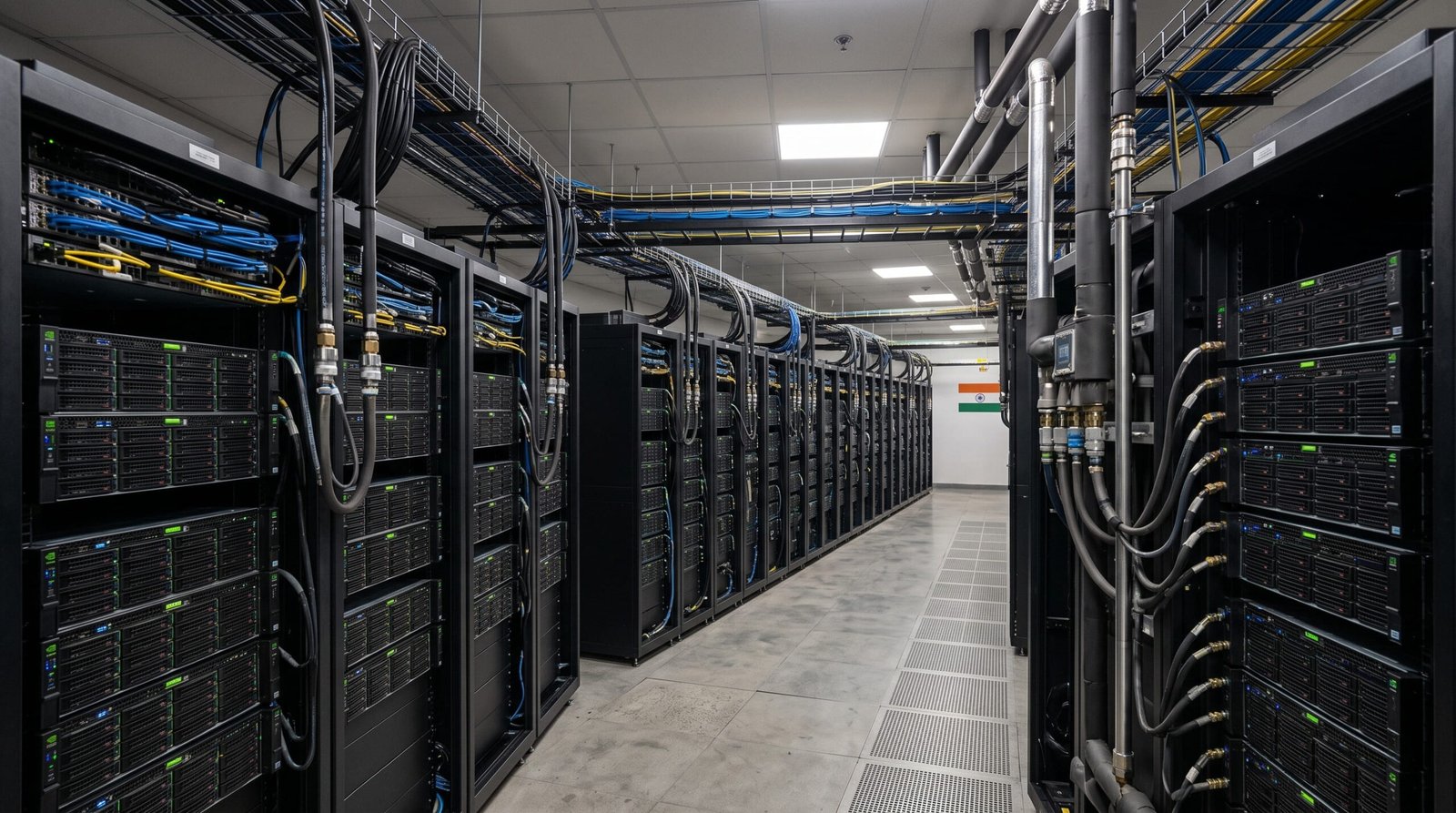
Understanding how GPU powers AI technology is no longer a topic only for engineers and data scientists. It is a business-critical question for every enterprise leader, IT head, and operations manager making infrastructure decisions in 2026.
Nvidia has been the biggest beneficiary of the AI revolution. AI data centers have primarily been powered by graphics processing units (GPUs) designed by Nvidia in the past three years. Behind every AI chatbot you use, every recommendation system that suggests your next purchase, every fraud detection system protecting your bank account, and every image recognition tool on your phone — there is a GPU running the computation.
India’s government understood this early. India’s AI policy in 2026 centers on the $1.25 billion IndiaAI Mission, which subsidizes 38,000+ GPUs at roughly $1 per GPU-hour and funds indigenous foundation models. If GPUs are important enough for the government to spend Rs 10,372 crore subsidizing them, they are important enough for every Indian enterprise to understand.
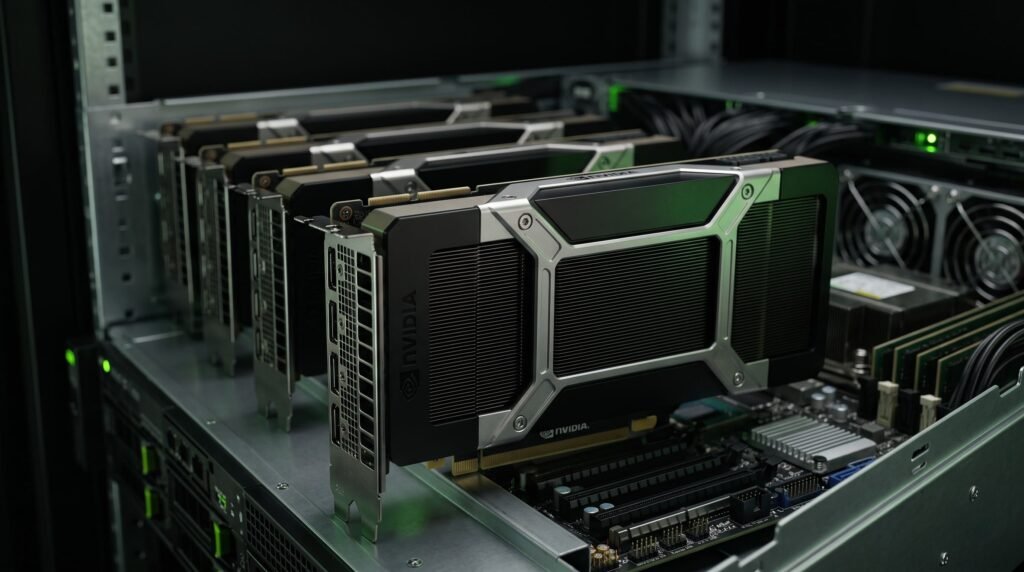
Table of Contents
- How GPU Powers AI Technology: The Simple Explanation
- GPU vs CPU — Why AI Needs a Different Kind of Chip
- What Happens Inside a GPU When AI Runs
- Why AI Data Centers Are Built Around GPU Clusters
- India’s GPU Infrastructure in 2026: Where Things Stand
- What This Means for Indian Enterprises Right Now
- How One World Logix Supports India’s GPU-Powered AI Infrastructure
1. How GPU Powers AI Technology: The Simple Explanation
A GPU is a Graphics Processing Unit. It was originally designed to render video game graphics — tasks that require processing thousands of simple calculations simultaneously rather than a few complex ones sequentially.
That parallel processing architecture turned out to be exactly what AI needs.
Training an AI model means adjusting billions of mathematical parameters across millions of data examples until the model learns to make accurate predictions. Each adjustment is a relatively simple calculation — a multiplication, an addition, a comparison. But there are billions of them, happening simultaneously.
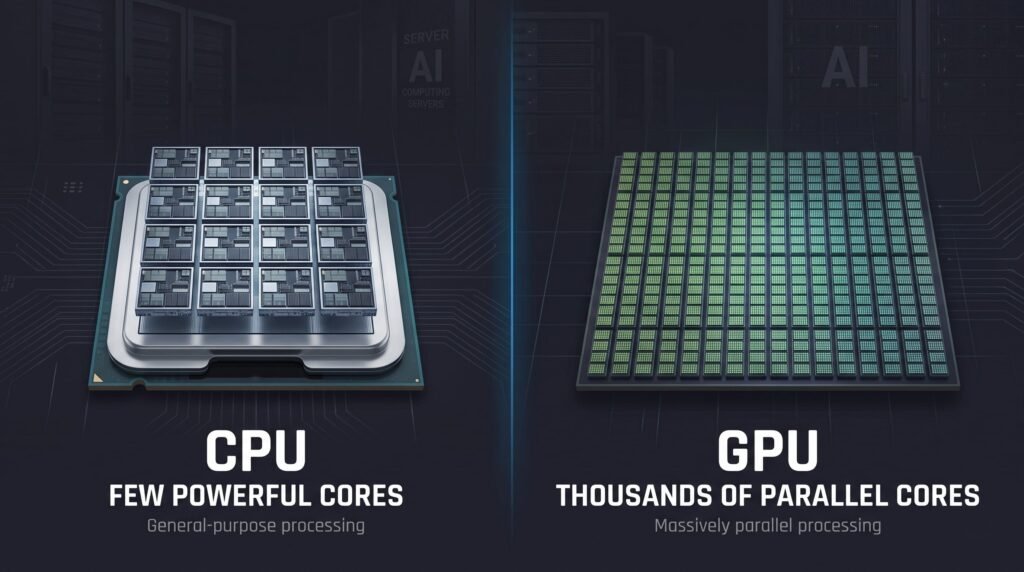
A standard CPU, the central processor in a laptop or server, handles tasks sequentially. It is extraordinarily powerful at complex single-threaded operations but was not built for massive parallelism. A modern CPU has 8 to 128 processing cores.
A modern AI GPU has 10,000 to 18,000 processing cores running simultaneously. That is why AI runs on GPUs.
GPUs provide the computational power. Data centers provide the physical foundation. Cloud computing provides flexibility and scalability. Networking connects the components, while advanced cooling and energy systems keep them running efficiently.
2. GPU vs CPU: Why AI Needs a Different Kind of Chip
The easiest way to understand the difference is through an analogy.
A CPU is like a small team of highly skilled specialists. Each person can handle complex, nuanced tasks with judgment and adaptability. But there are only a few of them.
A GPU is like a very large factory floor with thousands of workers doing simple, repetitive tasks simultaneously. No single worker is as capable as a specialist, but together they can process an enormous volume of work in a fraction of the time.
AI training is a factory floor problem. You are not solving one complex equation. You are solving the same type of simple equation billions of times across your entire dataset, updating a model’s parameters with each pass.
Unlike conventional cloud workloads, AI systems rely heavily on GPU clusters operating continuously at extremely high utilization rates. These deployments require dense rack configurations, high-throughput networking, and advanced thermal management systems.
This is why you cannot simply run AI workloads on existing enterprise server infrastructure. The compute architecture is fundamentally different, and the physical infrastructure requirements that follow from it are dramatically more demanding.
3. What Happens Inside a GPU When AI Runs
When an AI model processes a request, the following happens inside a GPU in fractions of a second.
Your input — a question, an image, a piece of text — is converted into numbers called vectors. The GPU loads the model’s parameters, which can number in the hundreds of billions for large language models. The GPU then performs what is called matrix multiplication: multiplying your input vectors against the model’s parameter matrices across thousands of parallel processing cores simultaneously.
The result of these multiplications passes through activation functions that determine which signals get amplified and which get suppressed — this is how the model “thinks.” The final output is then decoded back from numbers into the text, image, or decision that you receive.
For a single query to ChatGPT, this process happens across hundreds of GPU cores in milliseconds. For training a new AI model from scratch, this process happens trillions of times over weeks or months across thousands of GPUs running simultaneously.
High-speed networking including 100Gbps and 400Gbps backbone connections enables distributed training across multiple GPUs. Modern data centers deploy InfiniBand and high-speed Ethernet specifically for AI interconnect requirements.
The networking between GPUs is as important as the GPUs themselves. If the GPUs cannot communicate fast enough, they spend more time waiting for data than computing.
4. Why AI Data Centers Are Built Around GPU Clusters
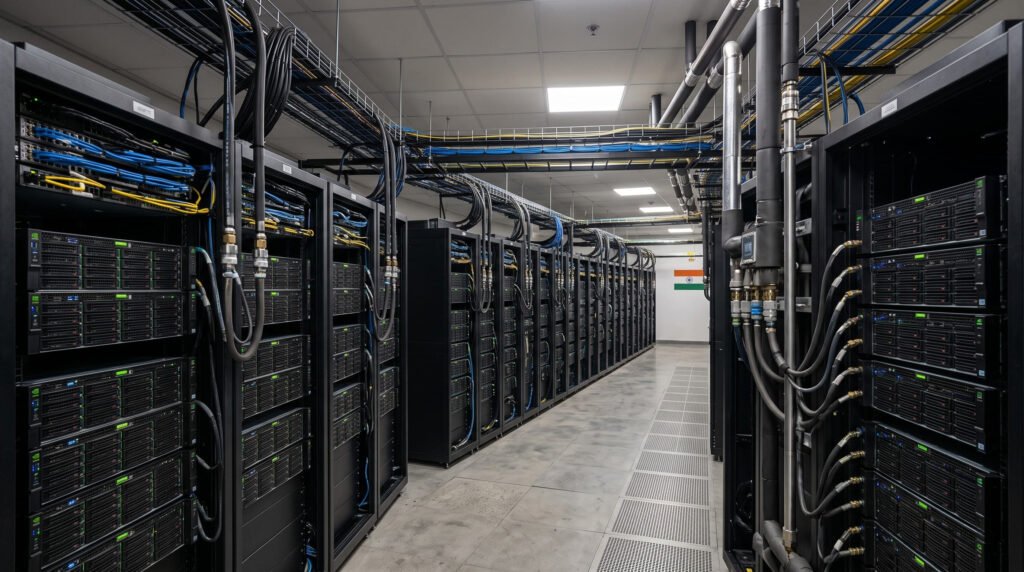
A standard enterprise data center was designed around CPU-based servers consuming 5 to 10 kilowatts per rack. An AI data center is designed around GPU clusters consuming 40 to 100 kilowatts per rack — sometimes more.
That difference changes everything about the physical facility.
Power delivery must be redesigned. A single Nvidia H100 GPU draws 700 watts of power. A rack of 8 H100s draws 5,600 watts from the GPU cards alone, before accounting for networking, storage, and cooling overhead. A 100-rack GPU cluster draws more power than a small industrial facility.
Cooling becomes the defining engineering challenge. Cooling is one of the biggest infrastructure challenges created by AI. As GPU density increases, conventional air cooling can become less effective for certain high-performance configurations. This is driving greater interest in liquid cooling and other advanced thermal-management technologies.
The physical weight of GPU racks is significantly higher than standard server racks. Floor load ratings that were adequate for CPU-based infrastructure may require structural reinforcement for GPU deployments.
AI-centric campuses in Hyderabad and Visakhapatnam are designed for high GPU density, advanced cooling architectures, and large-scale power availability. Some facilities target rack densities far beyond traditional enterprise deployments.
This is why enterprises cannot simply add GPU servers to an existing server room. The physical infrastructure requirements — power, cooling, floor load, networking — typically require either a new facility or a professionally planned migration to an AI-ready colocation environment.
5. India’s GPU Infrastructure in 2026: Where Things Stand
India’s GPU capacity has grown dramatically but demand still significantly outpaces supply.
Yotta Data Services has about 60% to 70% of India’s installed GPU capacity. In India, there is more demand for graphics processing units than there is supply. This is because AI startups and global IT companies are growing in the nation.
The government’s IndiaAI Mission is directly addressing this gap. 38,000+ subsidized GPUs are being made available at roughly Rs 83 per GPU-hour to Indian enterprises, startups, and research institutions. This is a deliberate policy to reduce dependence on expensive international cloud providers for AI compute.
PwC estimates that AI could contribute $15.7 trillion to the global economy by the end of the decade. Productivity gains will account for $6.6 trillion of that contribution, with another $9.1 trillion coming from consumer-related applications. India’s government is betting that access to affordable GPU compute will be a decisive factor in how much of that $15.7 trillion flows through Indian enterprises.
The private sector response has been significant. Google, Microsoft, Amazon, Meta, and AirTrunk have collectively committed over $100 billion to Indian AI infrastructure. Every one of these facilities is being built around GPU-optimized architecture — high-density racks, liquid cooling, high-speed interconnects, and massive power capacity.
6. What This Means for Indian Enterprises Right Now
The GPU-AI relationship has three practical implications for Indian enterprises making infrastructure decisions in 2026.
Your existing server room was almost certainly not built for GPU workloads. If your business is planning to deploy AI applications at any meaningful scale, you need to assess whether your current physical infrastructure can support the power density, cooling requirements, and networking speeds that GPU clusters demand. Most pre-2023 enterprise server rooms cannot.
The window to migrate to AI-ready infrastructure is now. As GPU-dense AI facilities come online across India — in Vizag, Hyderabad, Navi Mumbai, Chennai, and other cities — the cost of accessing AI-grade compute from professional colocation environments is becoming competitive with running your own infrastructure. Enterprises that migrate now will access better GPU connectivity, better reliability, and better scaling economics than those still running legacy setups.
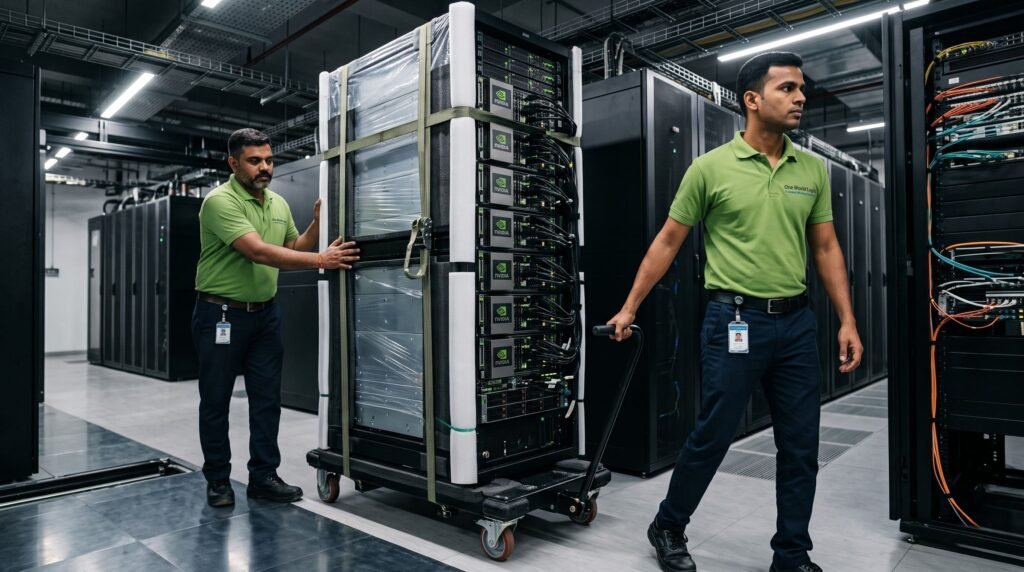
Physical migration is more complex for GPU infrastructure. Moving GPU servers requires more careful handling than standard enterprise servers. The cards are more valuable, more sensitive to electrostatic discharge, and more susceptible to vibration damage during transport. The packing methodology, transport vehicles, and recommissioning process for GPU infrastructure require specialist expertise that standard IT movers do not have.
7. How One World Logix Supports India’s GPU-Powered AI Infrastructure
One World Logix has been handling physical IT infrastructure migration across India and 30+ countries for 14 years. As GPU-powered AI infrastructure becomes the new standard for Indian enterprise data centers, we have built our physical migration capability specifically for the requirements this infrastructure creates.
GPU server migration is not the same as standard server migration. A rack of Nvidia H100 servers represents Rs 8 crore to Rs 25 crore of equipment. These cards are sensitive to electrostatic discharge, vibration, and temperature changes during transit. Our anti-static packaging, anti-vibration crating, and climate-aware transport methodology is designed specifically for high-value precision computing equipment.
When enterprises migrate from legacy server rooms to GPU-ready colocation facilities — or relocate from international locations to India’s new AI infrastructure hubs — we manage the complete physical scope: site assessment, specialized packing, transport, reinstallation, GPU cluster reconnection, and post-migration validation.
Our Global Field Engineer network operates in UAE, Bahrain, Singapore, UK, Germany, and 25+ other countries. For enterprises migrating GPU infrastructure from international locations to India’s growing AI data center ecosystem, we execute the complete physical scope under one project manager.
IAM certified. GEM empaneled. MSME registered. ISO 9001:2015 certified.
📞 +91-882-882-0887
📧 info@oneworldlogix.com
🌐 oneworldlogix.com/owl/data-center-migration/
Get a free site assessment today.