
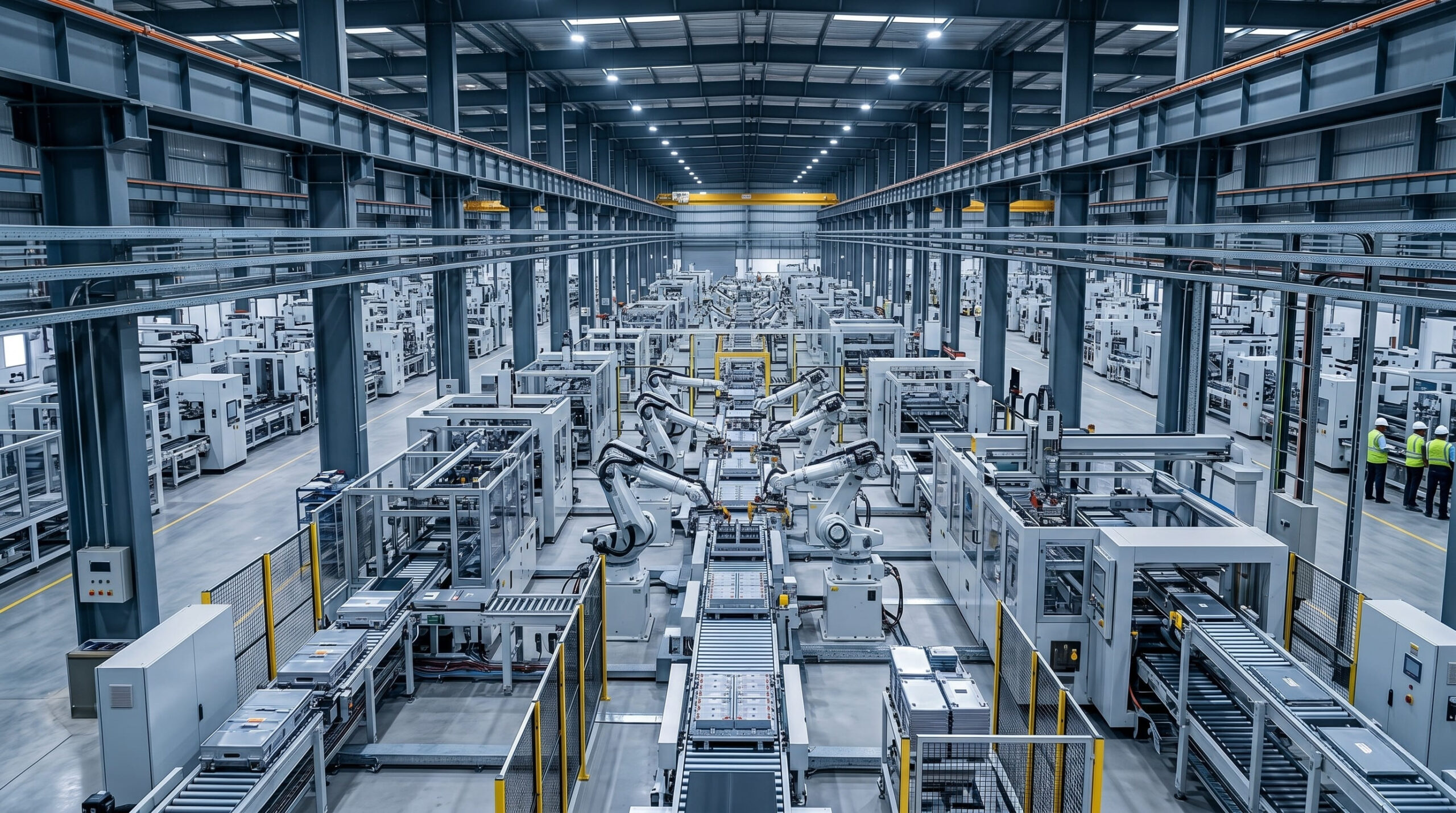
India’s gigafactory boom is real, it is massive, and it is moving fast.
Lead players, including Amara Raja, Exide, Ola Electric, and Reliance, are advancing rapidly, with production lines expected between 2025 and 2026. Reliance Industries is set to begin production at its battery gigafactory in Jamnagar, Gujarat, with an initial annual capacity of 40 GWh — with plans to scale modularly to 100 GWh. Adani Power is planning a 20 GWh LFP battery facility in Ahmedabad, while Agratas Energy — Tata’s global battery arm — is developing a 20 GWh plant in Sanand, Gujarat.
The numbers are staggering. Total disclosed investments exceed ₹20,000 crore across major projects, with India targeting a production capacity of 100 GWh by 2026.
But here is what nobody is talking about loudly enough: gigafactory relocation in India — moving battery manufacturing lines, electrode coating equipment, formation machines, and solar production equipment — is one of the most technically demanding industrial relocation challenges on earth. And most of the companies racing to set up or expand these facilities have never done it before.
This blog is for every operations head, plant manager, and project director at a company that is setting up, expanding, or relocating a gigafactory in India in 2026. What follows is everything you need to plan — and everything you need to avoid.
Table of Contents
- Why Gigafactory Relocation Is Completely Different from Standard Industrial Shifting
- India’s Gigafactory Landscape 2026 — Who Is Moving and Where
- The Equipment Inside a Gigafactory — What Actually Has to Move
- The Biggest Planning Mistakes in Gigafactory Relocations
- Gigafactory Relocation Cost in India — Real Numbers
- Step-by-Step: How a Professional Gigafactory Relocation Works
- Regulatory and Compliance Requirements for Battery Plant Relocation
- How One World Logix Handles Gigafactory and Large-Scale Industrial Relocation
1. Why Gigafactory Relocation Is Completely Different from Standard Industrial Shifting
Most industrial relocation companies will tell you they can handle a gigafactory move. Very few actually can.
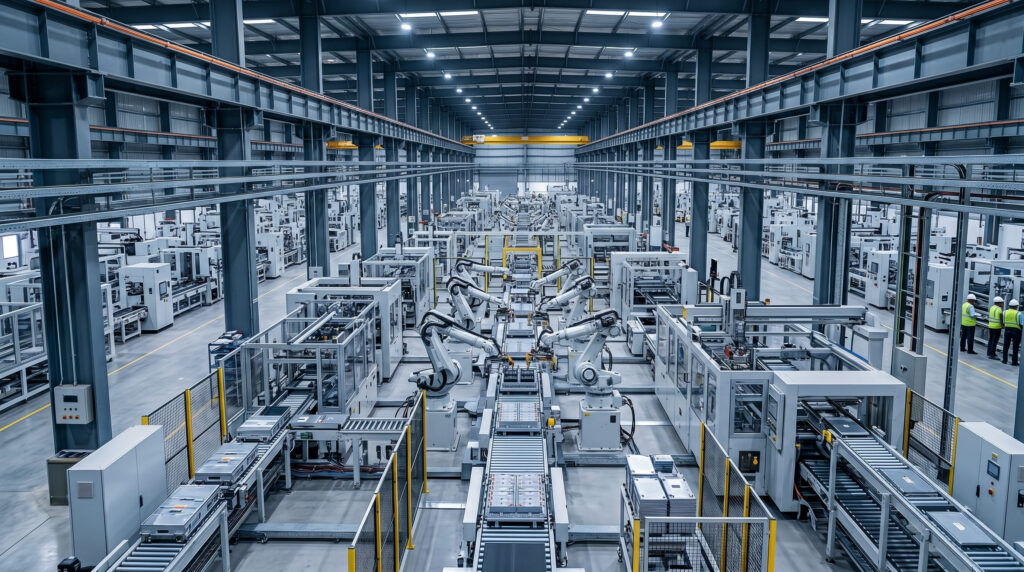
A gigafactory is not a large factory. It is an ecosystem. Battery cell manufacturing lines, electrode coating machines, formation and aging equipment, module assembly systems, and testing chambers all work together in a precisely engineered sequence. The tolerances involved are microscopic. The equipment is often imported from Germany, Japan, South Korea, or China and is worth hundreds of crores per production line. And unlike a standard press or CNC machine, battery manufacturing equipment is sensitive to temperature, humidity, vibration, and contamination in ways that most industrial movers have never encountered.
Moving this equipment requires mechanical engineers who understand battery manufacturing processes. It requires anti-vibration crating that goes several levels beyond what standard machine shifting demands. It requires climate-controlled transport for temperature-sensitive components. It requires a project management structure capable of coordinating across dozens of equipment categories simultaneously—and doing it without disrupting the production schedule of a facility that may be partially operational during the move.
Get it wrong and you are not looking at a delayed shipment. You are looking at electrode coating drums that have lost their calibration, formation chambers that need complete recommissioning from scratch, and production lines that produce out-of-specification cells from day one at the new site. The cost of getting gigafactory relocation wrong is not measured in lakhs. It is measured in crores.
2. India’s Gigafactory Landscape 2026 — Who Is Moving and Where
Understanding who is building and relocating gigafactories across India right now gives you the full picture of why this topic matters so urgently in 2026.
Reliance Industries — Jamnagar, Gujarat The Dhirubhai Ambani Green Energy Giga Complex in Jamnagar spans 44 million square feet of built-up area — equivalent to four times the size of the Tesla Gigafactory. Reliance Industries is starting battery gigafactory operations in the second half of 2026, leveraging electrochemical expertise from subsidiaries Lithium Werks and Faradion. The complex also houses gigafactories for solar modules and electrolyzers—making it one of the most complex multi-line industrial facilities ever built in India.
Agratas Energy (Tata Group)—Sanand, Gujarat: Agratas Energy Storage, Tata’s global battery business, has set up a 20 GWh LFP battery plant in Sanand, Gujarat, with a ₹13,000 crore investment. Jaguar Land Rover and Tata Motors are the initial customers. Construction is occurring in phases, with battery production slated to commence in 2026.
Ola Electric — Krishnagiri, Tamil Nadu Ola Electric’s gigafactory in Krishnagiri, Tamil Nadu, started with an initial capacity of 5 GWh and is scaling up to 20 GWh by 2026. The 115-acre facility focuses on NMC battery cell production with ambitions to bring the entire battery manufacturing supply chain in-house.
Adani Power—Ahmedabad, Gujarat: Adani Power is planning a 20 GWh LFP chemistry battery facility in Ahmedabad targeting both BEV and BESS applications.
Amara Raja — Telangana One of India’s fastest-moving battery manufacturers, with a 16 GWh LFP facility planned in Karakambadi and Divitipally in Telangana—targeting both EV and energy storage applications.
Exide Industries — Karnataka A 12 GWh greenfield facility in Karnataka, focusing on LFP chemistry for both mobility and stationary energy storage markets.
Every one of these projects involves the movement, installation, and commissioning of equipment that has never been done at this scale in India before. The relocation and installation expertise required is entirely new territory for the Indian industrial logistics industry.
3. The Equipment Inside a Gigafactory — What Actually Has to Move
Before you can plan a gigafactory relocation, you need to understand exactly what you are moving. Battery manufacturing equipment is unlike anything else in the industrial world.
Electrode Manufacturing Equipment Mixing machines that blend active materials, solvents, and binders into electrode slurry. Coating machines—some of them 100 meters long—that apply electrode material to copper or aluminum foil with micron-level precision. Calendaring machines that compress the coated electrode to exact thickness tolerances. Slitting machines that cut electrode rolls to precise widths. All of this equipment is precision-engineered, vibration-sensitive, and must be perfectly recalibrated after any move.
Cell Assembly Equipment Winding or stacking machines that assemble individual battery cells from electrode and separator materials. Electrolyte filling stations that operate in dry room environments — rooms where humidity is maintained below 1% relative humidity. Welding machines for tab and terminal connections. Leak testing and sealing equipment.
Formation and Aging Systems Formation equipment charges and discharges newly assembled cells through a precise electrical cycling process that forms the SEI layer and determines the cell’s final electrochemical characteristics. These systems represent some of the most significant capital investments in any gigafactory. Moving them incorrectly — or failing to recommission them properly — results in cells that fail quality control from the first cycle.
Module and Pack Assembly Lines Robotic assembly systems, laser welding equipment, automated testing stations, and battery management system installation equipment.
Dry Room Infrastructure Perhaps the most challenging aspect of gigafactory relocation is Dry rooms — the low-humidity environments essential for electrolyte handling and cell assembly — are built into the facility itself. Moving a gigafactory means either recreating dry room infrastructure at the new site before the equipment arrives, or managing a transition period with temporary humidity controls. This requires months of advance planning.
Testing and Quality Equipment End-of-line testers, cycle life testing chambers, thermal runaway testing equipment, and X-ray inspection systems.
Each of these categories requires completely different handling, packing, transport, and reinstallation methodology. A company that has never moved battery manufacturing equipment before will not know the difference until something goes wrong.
4. The Biggest Planning Mistakes in Gigafactory Relocations
These are the mistakes that cost companies crores and months of lost production. They show up on almost every gigafactory relocation that is not professionally managed from the start.
Starting infrastructure preparation too late at the new site. Gigafactory equipment cannot arrive at a new site and be installed the same week. The new facility needs foundation work, utility infrastructure, dry room construction, compressed air systems, electrical capacity, and cooling systems—all ready before the first piece of equipment arrives. Most companies start this work too late and then discover they cannot commission equipment that is already sitting on the factory floor.
Underestimating disassembly complexity. Battery manufacturing lines are interconnected systems. You cannot disassemble a coating line the same way you disassemble a standalone press. Every connection point, every utility feed, every mechanical interface must be documented and photographed before a single bolt is removed. Companies that skip thorough disassembly documentation spend weeks trying to remember how everything was connected at the new site.
Moving everything at once. The temptation in gigafactory relocations is to move everything simultaneously to minimize total downtime. This is almost always a mistake. A phased approach—move pilot equipment first, commission and validate it, then move production equipment—surfaces problems on lower-stakes equipment before your most critical production lines are at risk.
Ignoring supply chain implications during the move. A gigafactory relocation takes weeks or months. During that time, your customers—EV manufacturers and energy storage integrators—are receiving no cells. If you have not arranged an alternative supply or communicated realistic timelines to customers well in advance, the commercial damage from a relocation can exceed the cost of the relocation itself.
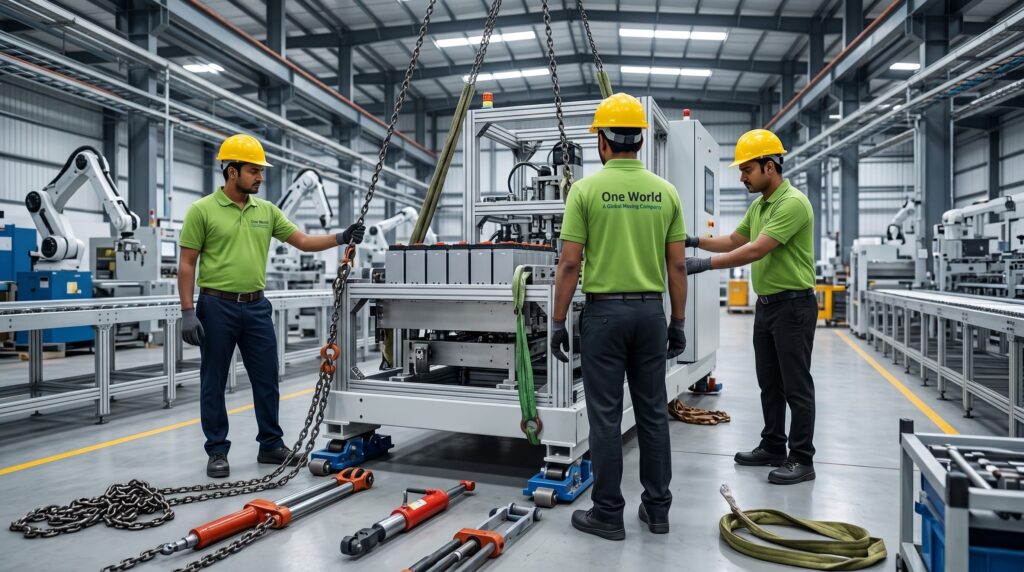
Choosing a generalist logistics company. This is the most expensive mistake of all. A company that has moved machine tools and automotive equipment has not moved battery manufacturing equipment. The handling requirements, the packing specifications, the transport conditions, and the commissioning process are completely different. Ask any vendor you consider: Have you specifically moved electrode coating lines? Formation equipment? Dry room infrastructure? If the answer is vague, keep looking.
5. Gigafactory Relocation Cost in India — Real Numbers
Gigafactory relocation costs are project-specific and vary enormously based on scale, equipment type, distance, and timeline. Here are realistic estimates to help with initial budget planning:
Single Production Line (e.g., one coating line + associated equipment)
- Assessment, engineering, and migration planning: ₹5 lakh – ₹15 lakh
- Specialized disassembly with OEM-certified engineers: ₹10 lakh – ₹40 lakh
- Custom crating, anti-vibration packaging, climate control during transit: ₹8 lakh – ₹30 lakh
- Specialized transport—multi-axle, climate-controlled where needed: ₹15 lakh – ₹60 lakh
- Reinstallation, calibration, and trial production run: ₹20 lakh – ₹80 lakh
- Single line total estimate: ₹58 lakh – ₹2.25 crore
Full Cell Manufacturing Gigafactory (multi-line)
- Complete project management and engineering: ₹20 lakh – ₹75 lakh
- Full disassembly and documentation: ₹50 lakh – ₹2 crore
- Packaging and transport of all equipment: ₹1 crore – ₹8 crore
- Full reinstallation, utility reconnection, commissioning: ₹2 crore – ₹10 crore
- Post-move production validation and quality sign-off: ₹50 lakh – ₹2 crore
- Full gigafactory relocation estimate: ₹4 crore – ₹22 crore+
International Equipment Import (Germany/Japan/Korea to India) Add customs clearance, import duties, sea or air freight, and overseas field engineer coordination. International equipment installation typically adds 40-80% over the domestic equivalent.
The most important thing to understand about gigafactory relocation costs: the cost of production downtime during the move almost always exceeds the physical relocation cost. A gigafactory producing cells worth ₹10 crore per month loses ₹33 lakh for every day of unplanned downtime. Professional planning that reduces the move by one week pays for itself many times over.
6. Step-by-Step: How a Professional Gigafactory Relocation Works
Phase 1 — Discovery and Assessment (4-8 weeks before move) Complete equipment inventory across all production lines. Engineering assessment of disassembly requirements for every machine category. New site assessment — infrastructure readiness, utility capacity, dry room specifications, access routes. Risk identification and mitigation planning. Timeline development with milestones and contingency buffers.
Phase 2 — New Site Preparation (parallel with Phase 1) Foundation and civil work where required. Electrical infrastructure — transformer capacity, distribution panels, earthing. Compressed air, cooling water, nitrogen, and other utility systems. Dry room construction or modification. Equipment positioning markings and foundation bolt preparation.
Phase 3—Pre-Move Preparation (2-4 weeks before move) OEM notification and service engineer coordination for equipment requiring OEM presence during disassembly. Procurement of custom crating, anti-vibration materials, and moisture barriers. Customer supply chain communication and alternative supply arrangements. Staff briefing and safety induction for all team members.
Phase 4 — Disassembly and Packing Systematic shutdown and electrical isolation in sequence. Photography and documentation of every connection, cable routing, and mechanical interface. Component-level disassembly by engineers familiar with each equipment category. Custom packing—anti-vibration crating for precision components, sealed moisture-proof packaging for humidity-sensitive equipment, and individual labeling of every component and fastener.
Phase 5 — Transport Specialized vehicles matched to equipment dimensions and weight — low-bed trailers for heavy equipment, climate-controlled vans for sensitive electronics and control systems. GPS tracking for all high-value loads. Escorted movement for oversize loads. Real-time communication between transport and project management teams.
Phase 6 — Receiving and Positioning at New Site Systematic unloading in installation sequence—not in arrival sequence. Crane or rigging for heavy equipment positioning. Precise placement per engineering drawings before any connection work begins. Incoming inspection against pre-move condition photography.
Phase 7 — Reinstallation and Commissioning Mechanical reassembly by the same engineers who performed disassembly. Utility reconnection — electrical, compressed air, cooling water, nitrogen. Control system restoration and parameter verification. Dry room validation before electrolyte-related equipment commissioning. Trial run and production sample testing. Quality sign-off against pre-move baseline.
Phase 8 — Post-Move Validation Production yield comparison vs. pre-move baseline. Cell quality testing—capacity, internal resistance, and cycle life spot checks. Engineer sign-off and full documentation package. Handover to production team with all calibration records.
7. Regulatory and Compliance Requirements for Battery Plant Relocation
Gigafactory relocation in India involves regulatory requirements that standard industrial moves do not. Ignoring these adds weeks to your timeline and significant cost.
Hazardous Material Handling Battery manufacturing involves electrolytes, solvents, and electrode materials that are classified as hazardous under Indian law. Transport of these materials—even residual amounts left in equipment during disassembly—requires compliance with the Hazardous and Other Wastes Rules, 2016, and CPCB guidelines.
Factory Act Approvals Any change of location for a registered factory requires fresh registration under the Factories Act, 1948, at the new site before production can commence.
State Pollution Control Board NOC: A no-objection certificate from the State Pollution Control Board is required for the new facility before battery manufacturing can begin. This process takes weeks to months depending on the state. Starting this application early is critical.
Fire Safety NOC Battery manufacturing facilities require specific fire safety clearances given the thermal runaway risks associated with lithium-ion cells. The new facility must receive fire NOC from local authorities before production equipment can be commissioned.
GST and Asset Transfer Documentation Interstate movement of capital goods requires proper documentation under GST—e-way bills, asset transfer records, and GST reconciliation between states.
Import-Related Compliance (if equipment is imported) Equipment imported under EPCG or other duty exemption schemes has specific conditions around use and location. Relocating such equipment may require customs notification or reassessment.
Getting compliance right requires advance planning — not last-minute filing. Build regulatory timelines into your relocation plan from day one.
8. How One World Logix Handles Gigafactory and Large-Scale Industrial Relocation
One World Logix has been handling industrial machine shifting and plant relocation for 14 years across India and 30+ countries. Gigafactory and large-scale battery manufacturing relocation are some of the most demanding categories we work in—and we have built our capability specifically for it.
Engineering-led approach from day one. Our team includes mechanical and electrical engineers who assess, plan, and execute every phase of a gigafactory relocation. We do not treat large industrial moves as a logistics problem. We treat them as an engineering problem with a logistics component.
Battery and renewable energy sector experience. We have worked in the battery and renewable energy sectors across India—understanding the specific equipment categories, the handling requirements, and the commissioning demands that are unique to this industry. This is not general industrial knowledge. It is sector-specific expertise.
Specialized packing for precision equipment. Anti-vibration crating, custom foam inserts, moisture barriers, climate-controlled transport for temperature-sensitive components — our packing methodology was developed for equipment where standard industrial packing is simply not good enough.
Full-scope project management. Assessment, planning, infrastructure coordination, disassembly, packing, transport, reinstallation, commissioning, documentation, and post-move support — under one project manager, with one point of accountability. You do not coordinate between five different vendors while your production equipment sits waiting.
Global capability for imported equipment. For companies importing equipment from Germany, Japan, South Korea, Taiwan, or China, our Global Field Engineer network means we can coordinate the overseas disassembly, packing, and export clearance; manage the international freight; handle Indian customs clearance; and execute the installation at your Indian facility. One partner, complete scope.
Certifications that enterprise clients require. ISO 9001:2015 certified, IAM certified for international moves, GEM enpaneled, and MSME registered. For large enterprises and PSU clients, compliance documentation is not optional — and we provide it as standard on every project.
Free site assessment before any commitment. Before we give you a number, we send our engineers to your facility. We assess your equipment, your new site, your timeline, and your constraints. Our quotes are built on engineering reality, not assumptions. No surprises mid-project.
Final Thought
India’s gigafactory ambition is one of the most exciting industrial stories happening in the country right now. The scale of investment, the technology being deployed, and the long-term impact on India’s energy independence make this a genuinely historic moment for Indian manufacturing.
But ambition without execution precision costs crores. Gigafactory relocation in India in 2026 is a discipline where the difference between a professionally managed move and an amateur one is measured in production yield, equipment lifespan, and months of commercial impact.
The companies that get this right — that plan early, hire specialists, and treat the relocation as the engineering project it actually is — will commission their new facilities on time and hit their production targets from day one.
The ones that treat it as a logistics task will spend the next six months troubleshooting.
One World Logix is ready to be your gigafactory relocation partner—wherever you are moving from and wherever you are moving to.
📞 +91-88288 20887 📧 info@oneworldlogix.com 🌐 oneworldlogix.com/owl/machine-shifting/
Request a free site assessment today.