
Manage your data center relocation with this expert checklist, built on PRINCE2 principles to guarantee business continuity.
Data center relocation is a risky decision. Planning needs to be methodical in order to achieve zero downtime. The purpose of this 10-phase checklist is to reduce risks and guarantee business continuity.
This comprehensive plan breaks down the complex data center relocation process into 10 predictable, manageable phases, ensuring a safe and seamless transition for your mission-critical assets.
Phase 1: Deep-Dive Discovery and Inventory for data center relocation
Success starts with understanding your environment perfectly.
- The Comprehensive Asset Audit: Document every component’s serial number, rack position, power requirements, and associated software licenses. You cannot safely move what you don’t fully understand.
- Application Dependency Mapping: This is critical. Chart the precise sequence in which systems must be powered down and powered back up (e.g., database before application). This map guides the entire move.
- Action: Create a verified, itemized list and a sequence map of your entire environment.

Phase 2: Strategy, Risk, and Methodology Selection
Your chosen strategy dictates your entire risk profile and mitigation plan.
- Big Bang vs. Phased: Will you risk a Big Bang (everything at once) or use a phased approach?
- Expert View: We recommend a Phased Approach. This strategy, managed using the structured PRINCE2 methodology, allows you to move assets in low-risk groups, minimizing the threat of a major outage.
Phase 3: Backup Validation and Contingency Planning
This phase ensures you have an escape route if required.
- Backup Validation: Don’t just verify your backups exist – test the restore procedures fully.
- Rollback Plan: Define a clear Rollback Plan and Go/No-Go checkpoints to confirm when it’s safe to proceed or necessary to revert to the old site.
Phase 4: New Site Readiness Certification
The new home must be proven ready before any equipment leaves the old location.
- Environmental Verification: Confirm the new location’s power capacity, cooling load (BTU capacity), and the floor weight limit can support the incoming infrastructure.
- Network Pre-Staging: Ensure new network switches and external carrier cross-connects are installed and certified before the servers are scheduled to arrive.
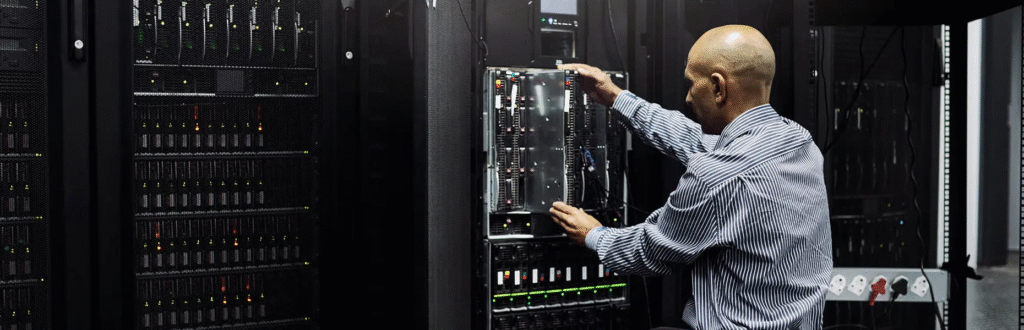
Phase 5: Dismantling & Specialized Packing
This is where physical risk is highest; precision is mandatory.
- Match-Marking: Every single cable must be clearly labeled at both ends to guarantee correct reconnection.
- Protection: Equipment is secured using anti-static 7-layer packaging and custom, shock-absorbing crates designed specifically for delicate IT infrastructure.
Phase 6: Secure Transportation & Monitoring
Security and integrity must be maintained during transit.
- Chain-of-Custody: Utilize specialized air-ride suspension vehicles and maintain a strict Chain-of-Custody with security escorts.
- Monitoring: Assets are monitored with real-time GPS and environmental sensors (for shock and temperature) to maintain asset integrity throughout the journey.
Phase 7: Unloading, Racking, and Re-Cabling in Data Center Relocation
The methodical process of setting up the new environment.
- Precise Racking: Use specialized hydraulic server lifts for safe placement, following the new rack elevation diagrams exactly.
- Re-Cabling: Technicians re-cable using the Phase 5 match-marking, cross-referencing against the final network documentation.
Phase 8: Power-Up Sequencing & Zero-Downtime Proof
The critical power-up phase requires strict adherence to the planning documents.
- Sequencing: Power-up must strictly follow the Application Dependency Map (Phase 1) sequence for a controlled, clean system boot.
- Initial Testing: Verify basic functionality, power draw, and network connectivity.
Phase 9: Functional Testing and Final Sign-Off
This is how you formally certify the success of the move to the business.
- Performance Benchmarks: Compare post-move performance (latency, IOPS) against the pre-move baselines (Phase 3) to certify that performance was maintained or improved.
- Handover: Provide the client’s operations team with final documentation, including updated network diagrams, and secure formal sign-off.

Phase 10: Decommissioning and ITAD Management
The final phase secures the vacated site and ensures compliance.
- Compliance & Security: Certified, secure data destruction of all remaining storage media.
- ITAD Management: Manage IT Asset Disposition (ITAD) – the compliant disposal or recycling of retired equipment, minimizing environmental and security risks.
Partner with an Expert Data Center Relocation Team
By following this complete 10-Phase checklist, you minimize risk and secure your infrastructure’s future.
At One World Logix, our end-to-end service, built on the PRINCE2 framework, guarantees transparent costs and a predictable outcome. From pre-move Data Center Mapping to compliant ITAD Management, we manage every detail.