
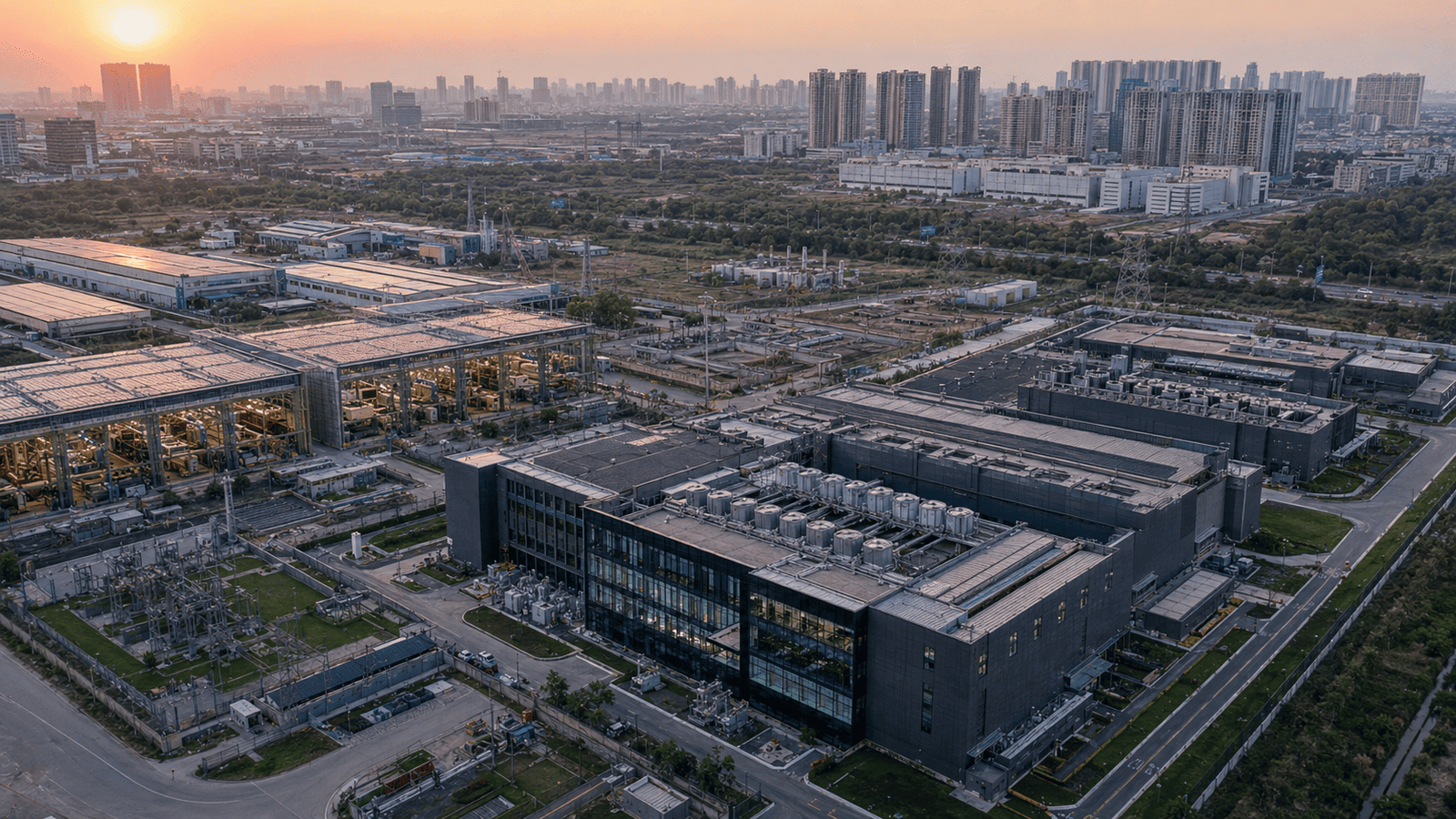
The AI Revolution India 2026 is not coming. It is already here, and it is moving faster than most Indian enterprises have planned for.
India’s AI infrastructure boom in 2026 is being driven by demand across data centers, hardware, AI chips, and cloud computing — with the government’s Rs 10,000 crore India AI Mission enhancing GPU capacity to over 38,000 units. Google, Microsoft, Amazon, Meta, and AirTrunk have together committed over $100 billion to Indian AI infrastructure. And at the AI-Powered Data Centre Conference held in Mumbai on July 22, 2026, industry leaders gathered under one theme: “From Capacity Gap to AI Superpower.”
India is no longer just consuming AI. It is building the physical infrastructure to power it — and that changes everything for enterprises running data centers, factories, and logistics operations across the country.
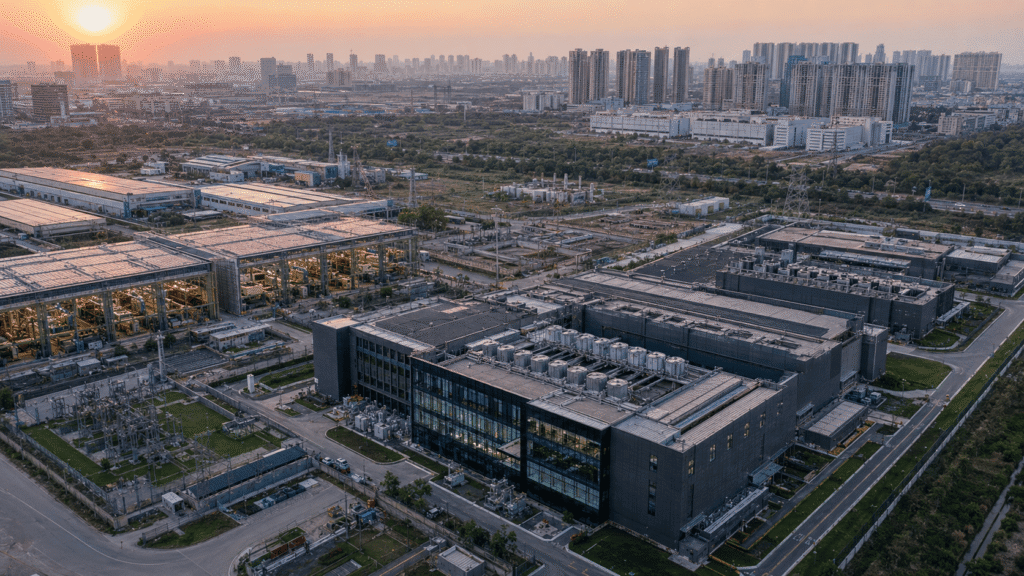
Table of Contents
- AI Revolution India 2026: The Scale of What Is Happening
- How AI Is Changing India’s Data Centers
- How AI Is Transforming Indian Factories and Manufacturing
- How AI Is Reshaping India’s Logistics and Infrastructure
- The Physical Infrastructure Challenge Nobody Talks About
- What Indian Enterprises Must Do Right Now
- How One World Logix Supports India’s AI Infrastructure Shift
1. AI Revolution India 2026: The Scale of What Is Happening
Before getting into sectors, understand the scale of what is being built.
According to Google’s AI Opportunity Agenda for India, AI has the potential to substantially boost the Indian economy — delivering at least Rs 33.8 lakh crore of economic value by 2030 and playing a crucial role in India’s target of a $1 trillion digital economy that accounts for 20% of GDP.
President Droupadi Murmu said at the SOAR-Skilling for AI Readiness programme that AI will play a significant role in India’s GDP, employment, and overall productivity in the coming decade, emphasizing that skills in data science, AI engineering, and data analytics will be critical to developing India’s AI talent pool.
Gautam Adani put it directly in his annual message for 2026: “The countries that successfully combine physical infrastructure with digital intelligence will be best placed to lead the global economy in the decades ahead.”
This is not a technology story. It is an infrastructure story. And infrastructure always has a physical dimension.
2. How AI Is Changing India’s Data Centers
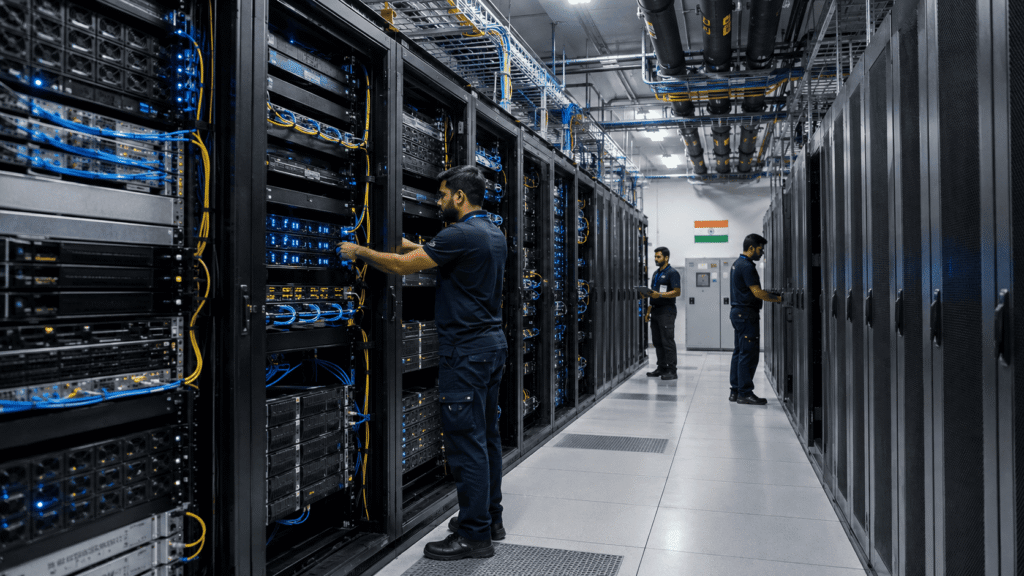
India’s data center landscape has changed more in the last 18 months than in the previous decade.
Industry leaders at the AI-Powered Data Centre Conference 2026 in Mumbai discussed how India can build the capacity, technology, and ecosystem required to emerge as a global AI infrastructure hub — with discussions covering investment trends, power infrastructure, advanced cooling technologies, sustainability, and enterprise expectations.
The reason AI has changed data centers so dramatically is compute density. A traditional enterprise server rack consumes 5 to 10 kilowatts of power. An AI-optimized GPU rack running large language models consumes 40 to 100 kilowatts. That is ten times the power in the same floor space, requiring completely redesigned cooling systems, power distribution, and physical layouts.
AI is no longer just a software story. It is a compute story, a power story, a cooling story, a water story, and a data-governance story. India’s opportunity lies not only in building more data centers, but in building them responsibly.
Every enterprise in India that has its own server room or uses a colocation facility built before 2023 is running infrastructure that was not designed for AI workloads. The gap between what they have and what AI-ready infrastructure provides is growing every month.
The companies that migrate their IT infrastructure to modern, AI-ready facilities in 2026 will be operating with a meaningful advantage over those still running legacy setups in 2027.
3. AI Revolution India 2026: How Factories and Manufacturing Are Changing
The AI Revolution India 2026 is transforming India’s logistics sector in three practical ways that affect every company moving goods or infrastructure across the country.
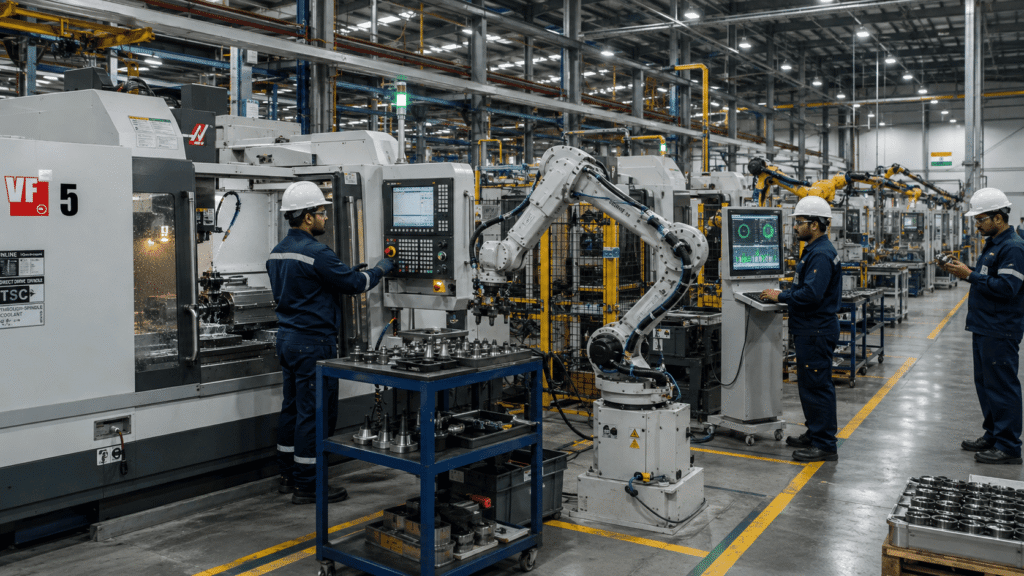
The AI revolution in Indian manufacturing is not about robots replacing workers. It is about making every process smarter, faster, and less wasteful.
Predictive maintenance is the most immediate change. AI systems connected to sensors on CNC machines, injection moulding presses, and production lines can now detect wear patterns and predict failures days before they happen. A factory that would have experienced an unplanned two-day shutdown is instead scheduling a four-hour maintenance window. The production loss difference is enormous.
Quality control has transformed. Computer vision systems trained on thousands of images can identify defects on production lines faster and more accurately than human inspectors. For pharma companies, food processors, and precision component manufacturers, this is not incremental improvement. It is a fundamental change in how quality is assured.
Supply chain optimization is where AI is delivering some of its biggest returns. AI systems analyzing demand signals, logistics data, and production capacity are reducing inventory costs while improving on-time delivery rates. For Indian manufacturers competing globally, this is directly tied to export competitiveness.
The physical implication of all this AI adoption in factories is significant. AI systems need compute infrastructure. Compute infrastructure needs to be connected, maintained, and periodically upgraded or relocated as factories expand, consolidate, or move to new industrial zones.
4. How AI Is Reshaping India’s Logistics and Infrastructure
India’s logistics sector is being transformed by AI in three practical ways that affect every company moving goods or infrastructure across the country.
Route optimization has moved beyond simple GPS navigation. AI systems now factor in real-time traffic, weather, vehicle load, fuel efficiency, and delivery windows simultaneously — cutting logistics costs meaningfully for companies running large fleets.
Warehouse management has changed fundamentally. AI-driven warehouse systems track inventory in real time, optimize picking routes, predict restocking needs, and reduce the human error rate in order fulfillment. For companies running contract logistics or large distribution operations, this is a direct bottom-line impact.
Port and customs processing is getting faster. AI document processing systems are reducing customs clearance times for imports and exports, which matters significantly for Indian companies shipping machinery, IT equipment, or industrial goods across borders.
For companies like One World Logix that handle physical infrastructure relocation across India and globally, AI is changing how projects are assessed, planned, and tracked — improving accuracy, reducing surprises, and giving enterprise clients better visibility into every phase of a complex migration.
making citizens digitally native, but the physical infrastructure that makes digital services possible still needs to be built, moved, and maintained by specialists.
5. The Physical Infrastructure Challenge Nobody Talks About
Here is what most AI coverage misses entirely.
Every gigabyte of data that AI processes, every GPU rack that trains a model, every factory sensor that feeds an AI system. All of it has a physical dimension. Servers, storage arrays, networking equipment, cooling systems, power distribution units. These are real objects that sit in real buildings and need to be moved when businesses grow, relocate, or upgrade.
The AI Revolution India 2026 is creating the biggest wave of physical infrastructure migration India has ever seen.
Companies are moving from legacy server rooms to AI-ready colocation facilities. Factories are relocating to new industrial zones with better connectivity and power. Enterprises with infrastructure in the Gulf region, affected by ongoing conflict, are migrating to safer India-based locations.
Union IT Minister Ashwini Vaishnaw noted at the AI Impact Summit 2026 that nearly 90% of India is now covered by 5G, making citizens digitally native — but the physical infrastructure that makes digital services possible still needs to be built, moved, and maintained by specialists.
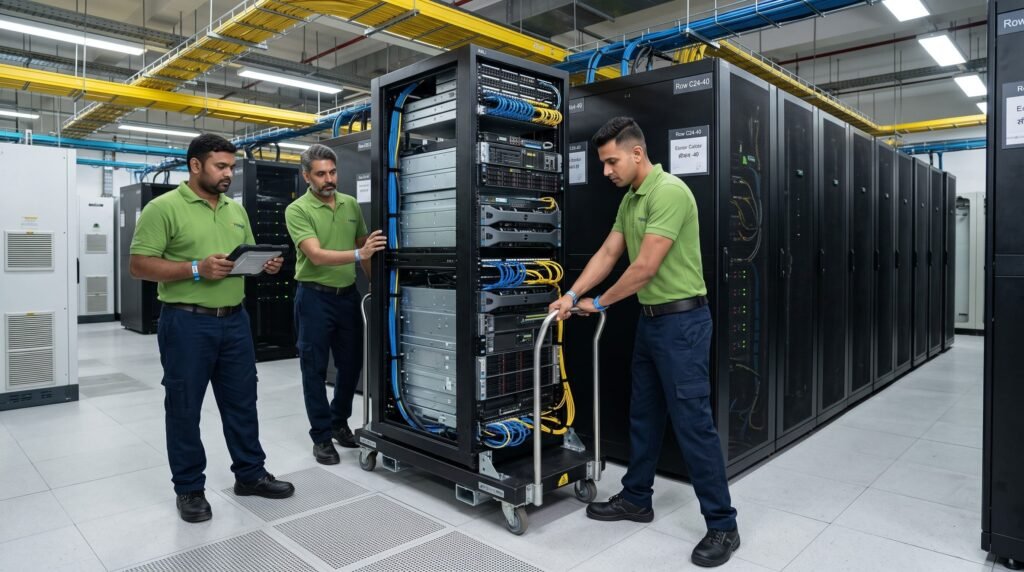
Physical infrastructure does not migrate itself. It needs professional handling: site assessment, anti-vibration packing, secure transport, reinstallation, and commissioning at the new facility. Getting this wrong does not just cause downtime. In 2026, it can mean falling behind on AI adoption timelines that directly affect competitive position.
6. What Indian Enterprises Must Do Right Now
The AI Revolution India 2026 is creating both an opportunity and a deadline.
The opportunity is that the infrastructure being built right now — Google’s Vizag hub, Microsoft’s Hyderabad facility, AirTrunk’s Maharashtra campus — represents the most capable, most affordable, and most AI-ready compute environment India has ever had access to. Enterprises that move their infrastructure to these environments will be positioned to leverage AI in ways that are simply not possible on legacy setups.
The deadline is that this window is not permanent. Colocation space in Navi Mumbai is already seeing a fight for land at higher prices. AI-ready GPU capacity is being reserved months in advance. Enterprises that plan their migrations now will secure better locations, better pricing, and faster AI timelines than those who wait.
Three things to do immediately: assess your current infrastructure honestly against AI-ready benchmarks, understand the gap between what you have and what AI workloads require, and identify a physical migration partner who can execute the transition without disrupting your operations.
7. How One World Logix Supports India’s AI Infrastructure Shift
One World Logix has been handling the physical layer of infrastructure migration across India and 30+ countries for 14 years. The AI Revolution India 2026 is the biggest driver of migration activity we have ever seen.
Every new AI-ready data center that comes online needs enterprises to migrate into it. Every factory adopting AI needs its equipment infrastructure assessed, sometimes relocated, and always connected. Every company moving IT infrastructure from a legacy environment to a modern one needs the physical relocation handled professionally.
We provide complete physical relocation of IT infrastructure including site assessment, specialized anti-vibration IT packing, transport, reinstallation, and commissioning. For machine and factory relocation, our in-house engineering team handles dismantling, transport, and full recommissioning across 9 industrial sectors.
Our Global Field Engineer network operates in UAE, Bahrain, Singapore, UK, Germany, and 25+ other countries, meaning we support migrations from any international location to India-based AI-ready facilities.
IAM certified. GEM empaneled. MSME registered. ISO 9001:2015 certified.
📞 +91-882-882-0887
📧 info@oneworldlogix.com
🌐 oneworldlogix.com/owl/data-center-migration/
Get a free site assessment today.