
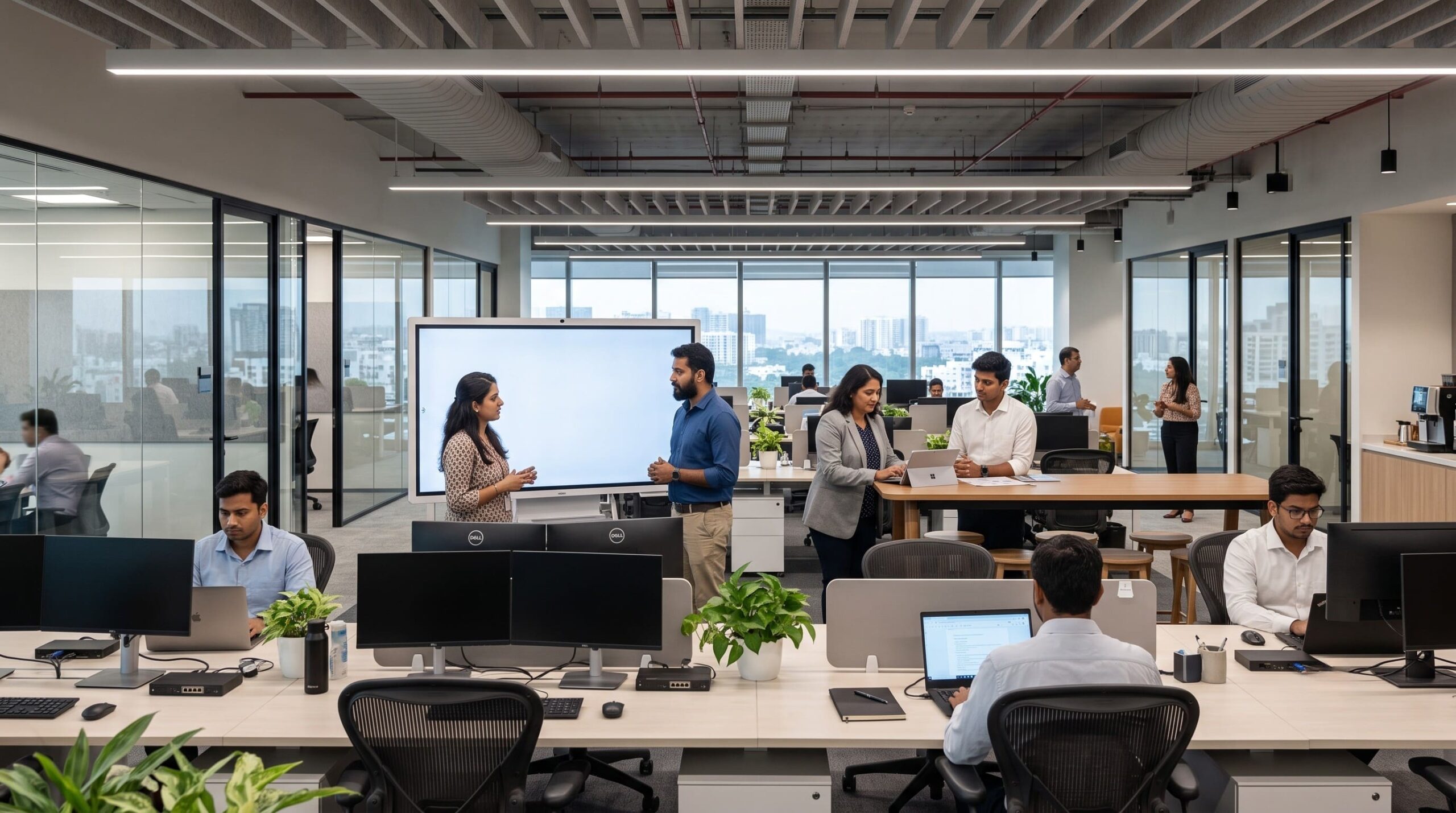
GCC office setup India is the fastest-growing segment in commercial real estate right now. In Q1 2026 alone, Global Capability Centres leased 9.1 million sq ft of office space across India’s top cities, the highest quarterly absorption ever recorded for this segment, according to CBRE. That single quarter accounted for 44 percent of all office leasing in the country.
The numbers behind this are not projections built on optimism. India currently hosts over 2,100 GCCs employing more than 2 million professionals across technology, analytics, engineering, and digital transformation roles, according to the Zinnov-NASSCOM India GCC Landscape Report 2026. Revenue from India’s GCC sector is on track to cross $100 billion by 2030, up from $64.6 billion in FY2024. The sector is growing at 11 to 13 percent annually in new GCC setups.
For global enterprises planning their first India GCC or expanding an existing one, this guide covers what the market actually looks like in 2026, what a physical office setup and relocation costs city by city, and why the physical execution of a GCC move is as important as the strategy behind it.
Table of Contents
- GCC Office Setup India 2026: The Scale of What Is Happening
- Which Cities Are Winning the GCC Race and Why
- Tier 2 Cities: The Cost Advantage Nobody Should Ignore
- What a GCC Office Setup Actually Costs in 2026
- The Physical Relocation Layer Most GCC Plans Miss
- What Enterprises Must Get Right Before Moving In
- What Indian Enterprises and Global CIOs Must Do Right Now
- How One World Logix Supports Your GCC Office Setup and Relocation
1. GCC Office Setup India 2026: The Scale of What Is Happening
India is not just a GCC destination. It is the GCC capital of the world. India contributes 40 percent of the global GCC workforce and the Zinnov-NASSCOM 2026 report confirms 2,117 unique GCC organisations running 3,728 units across the country, a 32 percent growth since FY2021.
In 2025 alone, GCCs accounted for an unprecedented 38 percent of office leasing across India’s top seven cities, securing 31.3 million square feet of space, the highest volume ever recorded. The momentum has only accelerated into 2026. In the first three months of 2026, GCCs together leased 9.1 million sq ft of office space, the highest quarterly absorption ever recorded for the segment, with 83 percent of it going to green-certified tech parks.
By 2030, India is expected to host over 2,500 GCCs employing 2.8 to 2.9 million professionals, contributing $105 billion in revenue to the global economy. These centres have evolved from simple cost centres to genuine innovation engines, driving digital transformation, R&D, and global leadership responsibilities from Indian cities
2. Which Cities Are Winning the GCC Race and Why
Not every city is equal in the GCC office setup India landscape, and picking the wrong location is the most expensive mistake a global enterprise can make at the planning stage.
Bengaluru remains the GCC capital with 34 to 39 percent of all activity and nearly 900 GCC units. It hosts GCCs for most leading global banks, cloud companies, and industrial majors, from Goldman Sachs and JP Morgan to Microsoft, Amazon, Zeiss, and Rolls-Royce. Bengaluru alone took 48 percent of GCC demand in Q1 2026, and rents have broken Rs 100 per sq ft per month for the first time.
Hyderabad is capturing 20 to 23 percent of the market with a strong focus on BFSI and analytics. It offers 20 to 30 percent lower operating costs than Bengaluru, with enterprise-grade infrastructure in HITEC City, Gachibowli, and the Financial District. Pune and Chennai provide balanced economics for enterprise technology, engineering, and QA-led centres. NCR commands higher premiums for product management, analytics, and consulting-oriented roles.
Mumbai rents have crossed Rs 125 per sq ft per month, making it the most expensive GCC market in India in 2026. Most GCCs treat Mumbai as a client-facing and senior leadership location rather than a large headcount base, given its rental premium over other cities.
3. Tier 2 Cities: The Cost Advantage Nobody Should Ignore
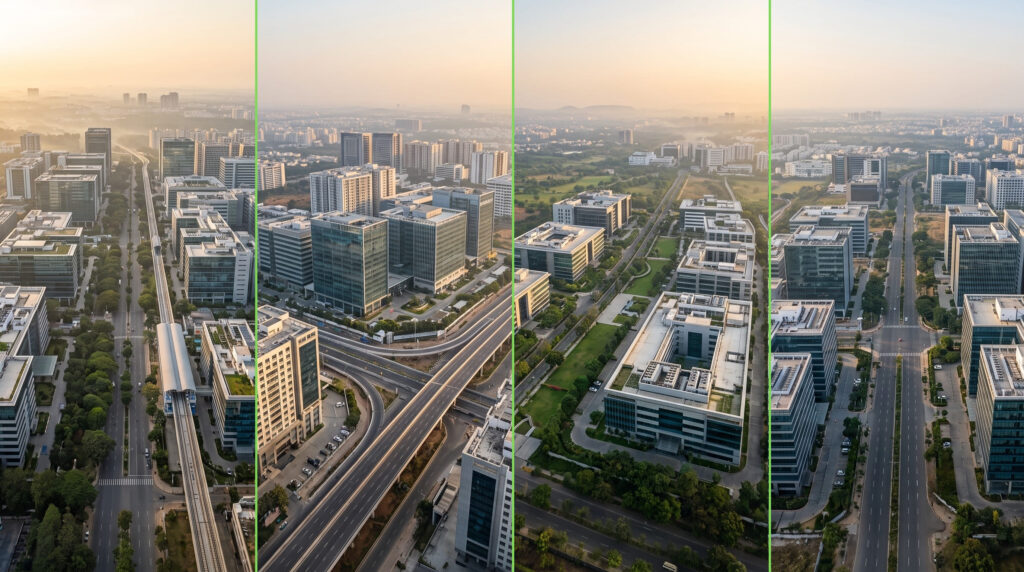
The most interesting GCC office setup India story in 2026 is not happening in Bengaluru. It is happening in Coimbatore, Kochi, Jaipur, Vadodara, Visakhapatnam, and Ahmedabad.
Tier 2 cities like Jaipur, Coimbatore, Ahmedabad, and Vizag are the fastest-growing GCC segment, offering 25 to 30 percent cost advantages and lower attrition, as part of a broader national policy push to distribute GCC growth more equitably. Talent pools in these markets have grown 25 to 30 percent in three years.
Over the next 3 to 4 years, GCC footprint is projected to cross 350 million sq ft nationwide, with emerging cities becoming important for cost, talent, and risk diversification. For companies running a distributed GCC model with a Bengaluru or Hyderabad core, adding a Coimbatore or Vadodara satellite centre can reduce fully-loaded per-seat costs by 20 to 30 percent without sacrificing capability.
The default workspace strategy in 2026 has shifted to roughly 70/30 owned-to-flex, with the 30 percent absorbing surge hiring, pilot teams, and Tier 2 expansion. The all-in, single-city, single-tower GCC approach carries concentration risk that most global enterprises are no longer willing to accept.
4. What a GCC Office Setup Actually Costs in 2026
Understanding the real cost of GCC office setup India helps global finance teams build accurate business cases and avoid mid-project surprises.
Grade A office spaces in Tier 1 cities like Bengaluru, Hyderabad, and Pune cost between Rs 50 to Rs 100 per sq ft per month. A 50,000 sq ft office space could cost approximately Rs 25 lakh to Rs 50 lakh per month in rental expenses. Per-seat office space in Hyderabad runs Rs 6,000 to Rs 16,000 per seat per month depending on micro-market, with HITEC City, Gachibowli, and the Financial District all sitting between Rs 70 and Rs 120 per sq ft.
Initial fit-out and furnishing including workstations, office interiors, lighting, and HVAC systems can range from Rs 50 lakh to Rs 2 crore, depending on the scale and customisation. IT infrastructure including servers, networking equipment, and software licenses may require an investment of Rs 1 crore to Rs 5 crore depending on operational requirements.
Incorporation costs for a Private Limited Company or LLP range from Rs 1 lakh to Rs 5 lakh, depending on the complexity of the setup and advisory fees. SEZ approvals add an additional layer of process and timeline. Talent remains the highest ongoing cost for most GCCs, with GCCs generally offering a 12 to 20 percent salary premium over traditional IT service firms for comparable tech roles and averaging 10.4 percent annual increments in 2026.
5. The Physical Relocation Layer Most GCC Plans Miss
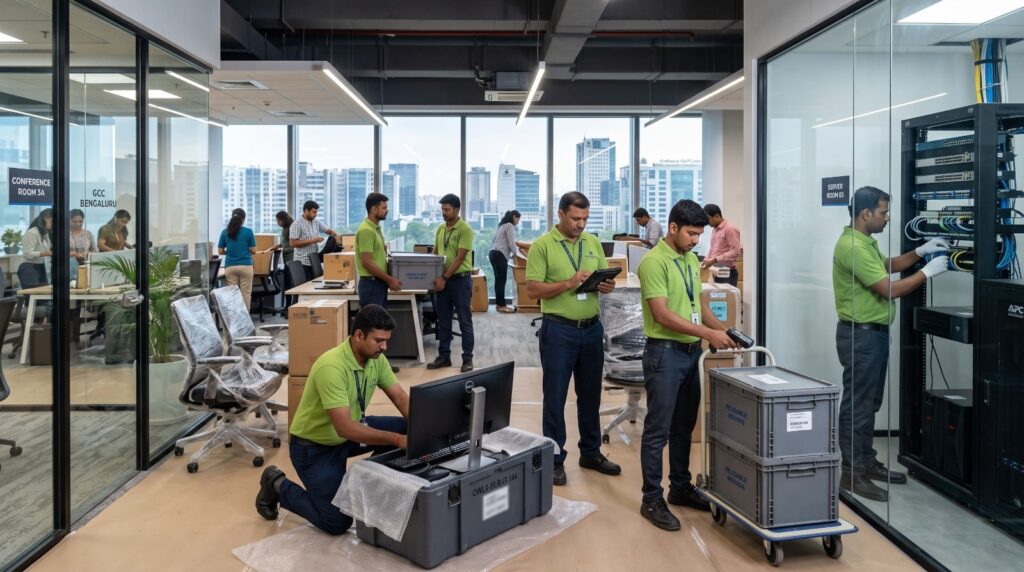
Here is where most GCC office setup India projects go wrong. The strategic planning is thorough. The real estate negotiation is handled. The legal and HR setup is managed. And then the physical move happens, and it costs more, takes longer, and causes more disruption than anyone budgeted for.
A 100-seat GCC office relocation with full IT equipment handling typically runs Rs 2.8 lakh to Rs 3.8 lakh for a local move. A 250-seat intercity move, for example Mumbai to Pune, commonly runs Rs 9.5 lakh to Rs 14 lakh. A 1,000-seat enterprise move between cities like Bangalore to Hyderabad typically falls in the Rs 35 lakh to Rs 50 lakh range.
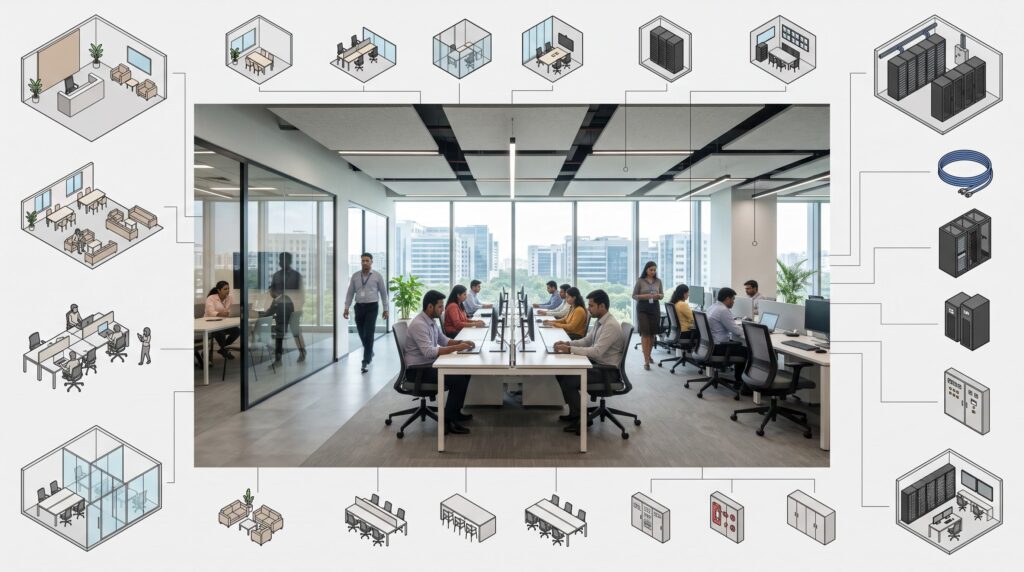
IT infrastructure relocation costs 40 to 60 percent more than standard office furniture shifting. Server rooms, networking racks, UPS systems, and conference room AV setups all require anti-static packing, certified handling, and trained technicians for dismantling and reinstallation. A server rack that arrives at the new facility incorrectly packed or improperly reinstalled can cause days of downtime that cost far more than the move itself.
Weekend and overnight execution adds 20 to 30 percent to the base price but eliminates 2 to 5 days of business downtime, which for an active GCC processing global work is almost always the cheaper option in total.
6. What Enterprises Must Get Right Before Moving In
The companies that execute GCC office setup India projects most smoothly are the ones that treat the physical move as a structured workstream, not an afterthought.
Start with a full asset audit of your current or source facility before requesting a single quote. Every workstation, server, switch, monitor, and piece of specialist equipment should be documented with serial numbers before anything is touched. This inventory is what separates an accurate relocation quote from a guess that changes mid-project.
Coordinate building access at both the old and new location a minimum of two weeks in advance. In Bengaluru and Mumbai particularly, commercial buildings have lift booking requirements, loading bay windows, and commercial vehicle permit restrictions that can delay a move by hours or a full day if not planned for.
Build IT validation time into your move timeline. A 200-seat GCC with a server room needs 24 to 72 hours of post-move testing and validation before it can be declared fully operational. Plan your go-live date around that window, not just the transport date.
7. What Indian Enterprises and Global CIOs Must Do Right Now
The GCC office leasing data makes one thing clear. Vacancy across the top eight markets has fallen from 17.2 percent in 2021 to 13.9 percent in Q1 2026. Grade A space in primary GCC corridors like Whitefield, HITEC City, and Hinjewadi is tightening. Companies that wait for a perfect moment to commit will find themselves queuing behind those who moved six months earlier.
For global enterprises entering India for the first time, the city selection and workspace strategy decision needs to happen before the legal entity setup, not after, because the city determines talent pool, rent benchmark, and physical relocation complexity simultaneously.
For existing GCCs expanding headcount or moving to larger or better-rated facilities, the physical relocation planning timeline should start at least 6 to 8 weeks before the move date for offices above 100 seats, and 10 to 12 weeks for anything above 300 seats. These timelines are not conservative. They are what a clean, zero-downtime move actually requires.
8. How One World Logix Supports Your GCC Office Setup and Relocation
One World Logix (OWL), headquartered in CBD Belapur, Navi Mumbai, is India’s Zero-Downtime Migration Specialists for exactly the kind of physical office and IT infrastructure relocation that GCC setup projects require. With 14 years of experience and projects executed across 30 countries, OWL handles GCC office moves from single-floor shifts to full campus relocations across multiple Indian cities.
OWL holds ISO 9001:2015 certification and is a member of IAM and GEM, the international standards bodies for migration. Every GCC office setup India project OWL handles includes a pre-move site survey, a full asset audit, line-item transparent pricing, and a zero-downtime execution plan built around the GCC’s operational hours and SLA commitments.
From IT server room decommissioning and reinstallation to workstation packing, AV system handling, and customs clearance for internationally shipped equipment, OWL manages the physical layer of your GCC move so your internal team can stay focused on the business side.
If your organisation is planning a GCC office setup or relocation in India, start with a free on-site assessment. No commitment, no cost.
Contact One World Logix today:
Phone: +91-88288 20887
Email: info@oneworldlogix.com
Website: oneworldlogix.com/owl/
Book your free GCC office relocation assessment. India’s GCC boom is filling up fast. Make sure your workspace move is planned correctly before space runs out.
“Relocating office IT? Our IT infrastructure relocation services handle workstations, servers, and network equipment end-to-end.”