
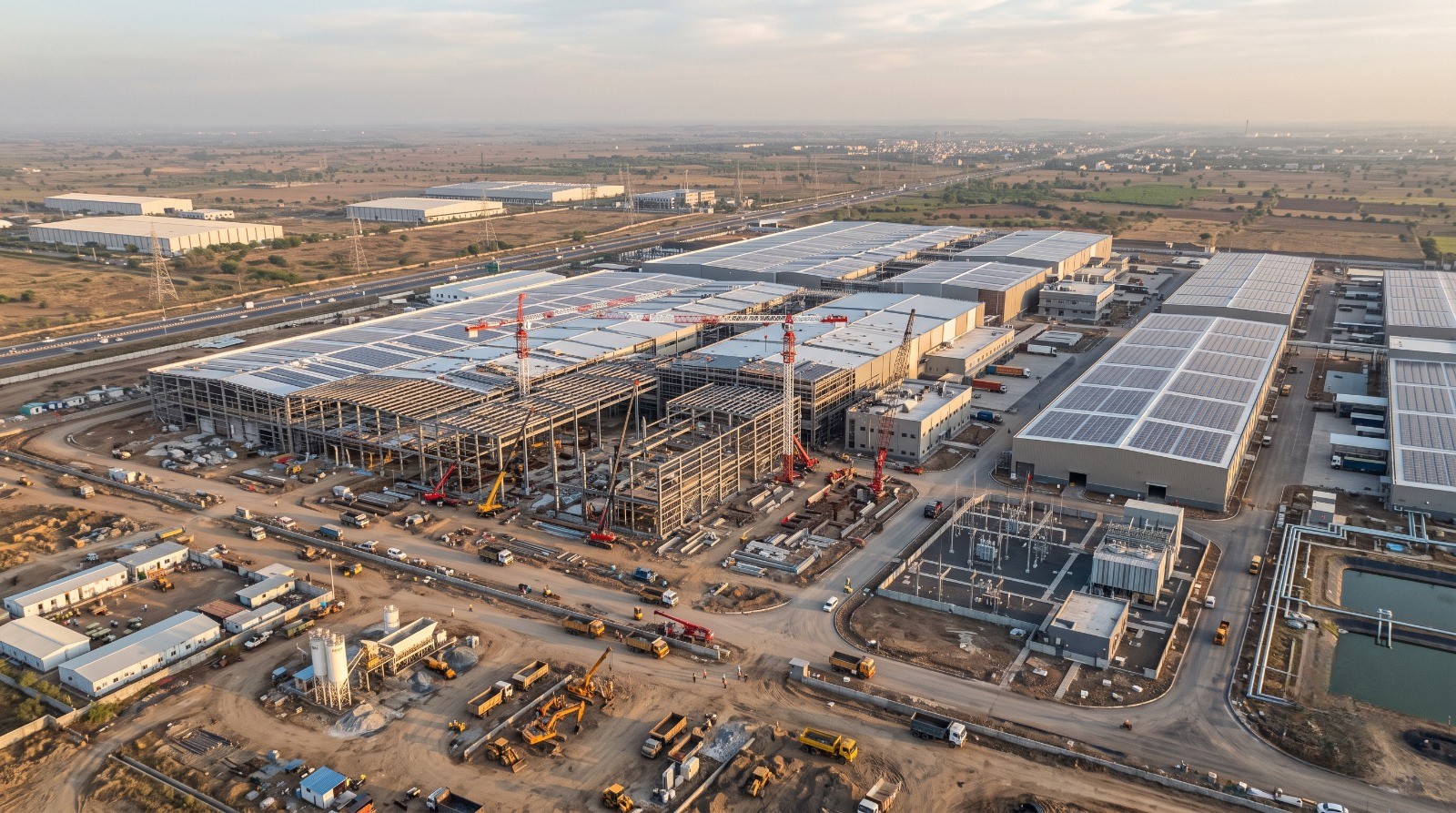
Gigafactory relocation India is no longer a phrase from a future-gazing report. It is happening on the ground right now, across Gujarat, Tamil Nadu, Telangana, and Karnataka, with combined investments that are reshaping India’s entire industrial geography.
Reliance Industries is ramping up its battery gigafactory at the Dhirubhai Ambani Green Energy Giga Complex in Jamnagar, with an initial capacity of 40 GWh scaling to 100 GWh. Tata’s Agratas Energy Storage is constructing a 40 GWh facility at Sanand, Gujarat, targeting commercial cell production in 2026-27. Ola Electric has already begun producing proprietary cells at its 115-acre Gigafactory in Krishnagiri, Tamil Nadu. Adani is planning a 20 GWh LFP facility in Ahmedabad. Amara Raja is building a 16 GWh plant in Telangana. By 2030, India is targeting more than 30 operational battery manufacturing sites with a combined capacity exceeding 290 GWh.
Every one of these gigafactories requires a massive physical relocation effort. Equipment, machinery, production lines, and IT infrastructure all need to move in, be installed correctly, and be commissioned without production delays. That physical layer is what this guide covers, alongside the data behind India’s battery boom, what is genuinely operational versus what is still in planning, and what enterprises near these corridors need to do right now.
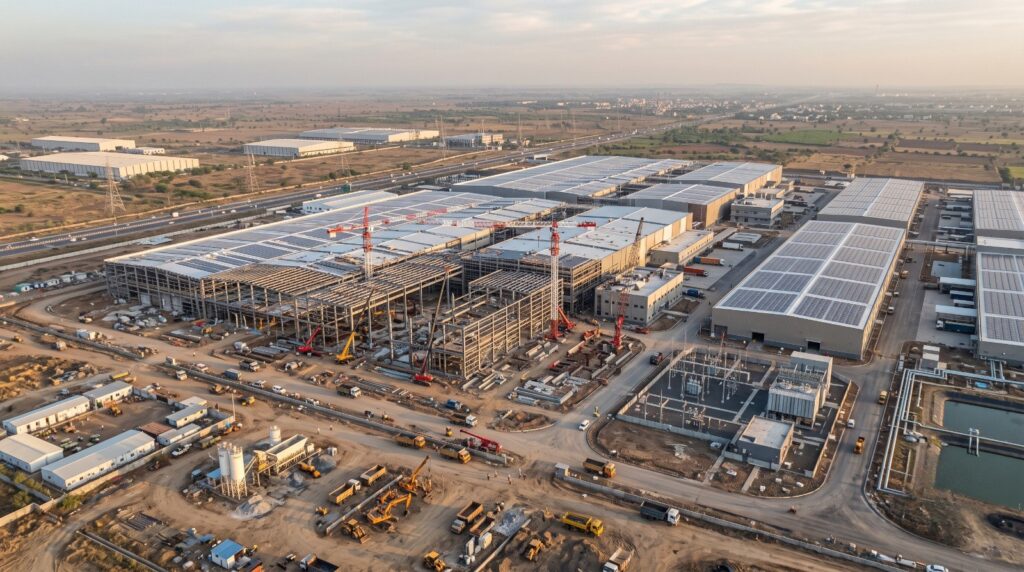
Table of Contents
- Gigafactory Relocation India: The Battery Boom Behind the Numbers
- Who Is Building What: Tata, Reliance, Ola, Adani, and More
- India’s Battery Geography: Where the Clusters Are Forming
- The Physical Side of Gigafactory Setup That Nobody Writes About
- What Machine and Equipment Relocation Into a Gigafactory Actually Costs
- The Honest Gaps: What India Still Needs to Fix
- What Manufacturers and Vendors Must Do Before This Window Closes
- How One World Logix Supports Gigafactory Relocation India Projects
1. Gigafactory Relocation India: The Battery Boom Behind the Numbers
India set an ambitious target of 50 GWh of lithium-ion battery manufacturing capacity by end of 2025. The honest reality: actual operational capacity as of early 2026 stands at only 1.4 GWh, almost entirely from Ola Electric’s Krishnagiri plant. The gap between announced capacity and commissioned production is significant.
But this does not mean the investments are hollow. It means the construction, equipment procurement, and relocation of manufacturing lines is happening right now, in 2026, at scale. Equipment orders have been placed with South Korean manufacturers for the Tata Sanand facility, with delivery targeted in H1 2026. Reliance’s electrolyzer gigafactory at Jamnagar is also scheduled to start production by end of 2026.
By 2030, India expects more than 30 manufacturing sites to be operational, targeting total production capacity exceeding 290 GWh. The capital moving to make that happen is very real. Total disclosed investments across major battery gigafactory projects already exceed Rs 20,000 crore.
2. Who Is Building What: Tata, Reliance, Ola, Adani, and More
The gigafactory relocation India story has several distinct chapters running in parallel.
Tata Group’s Agratas, its dedicated battery subsidiary, is constructing a 40 GWh gigafactory at Sanand in Gujarat. As of December 2025, the 320-acre facility had structural steel nearing completion with over 2,000 construction workers on site, with commercial cell production targeted for 2026-27 with Tata Motors and JLR as anchor customers.
Reliance Industries is set to begin production at its battery gigafactory in 2026, with an initial annual capacity of 40 GWh, later scaling to 100 GWh. The facility sits within the Dhirubhai Ambani Green Energy Giga Complex in Jamnagar, Gujarat, which spans 44 million square feet, roughly four times the size of Tesla’s Gigafactory.
Ola Electric operates both its Futurefactory and adjacent Gigafactory in Krishnagiri, Tamil Nadu. The Gigafactory, spread across 115 acres, began producing in-house 4680-format NMC cells at pilot scale, with Ola delivering vehicles powered by its proprietary Bharat Cells in late 2025. Adani Power is planning a 20 GWh LFP facility in Ahmedabad. Amara Raja is building a 16 GWh plant in Karakambadi, Telangana, and Exide Industries is commissioning a facility in Bengaluru, Karnataka, expected by end of FY26.
3. India’s Battery Geography: Where the Clusters Are Forming
One of the most important things to understand about gigafactory relocation India is that it is not spread randomly across the map. A clear clustering pattern is emerging.
Gujarat is emerging as India’s primary battery manufacturing geography, driven by port infrastructure for lithium carbonate imports, large industrial land availability, and state incentive schemes. Tata at Sanand, Reliance at Jamnagar, and Adani in Ahmedabad are all in Gujarat, making the state the undisputed battery manufacturing capital.
Tamil Nadu is the second major cluster, anchored by Ola Electric in Krishnagiri and Lucas TVS in Chennai. Telangana hosts Amara Raja, Godi Energy, and HBL Power Systems, making Hyderabad a third serious hub. Karnataka has Exide Industries and International Battery Company in Bengaluru.
The overall trend is toward clustering: vehicle manufacturing in Tamil Nadu, battery and cell manufacturing in Gujarat, powertrain components in Maharashtra, and additional battery capacity in Telangana. This industrial corridor logic is deliberate and mirrors how China built its own EV supply chain concentration over a decade.
4. The Physical Side of Gigafactory Setup That Nobody Writes About
Every announcement of a new gigafactory eventually comes down to the same physical reality: someone has to move the machines in.
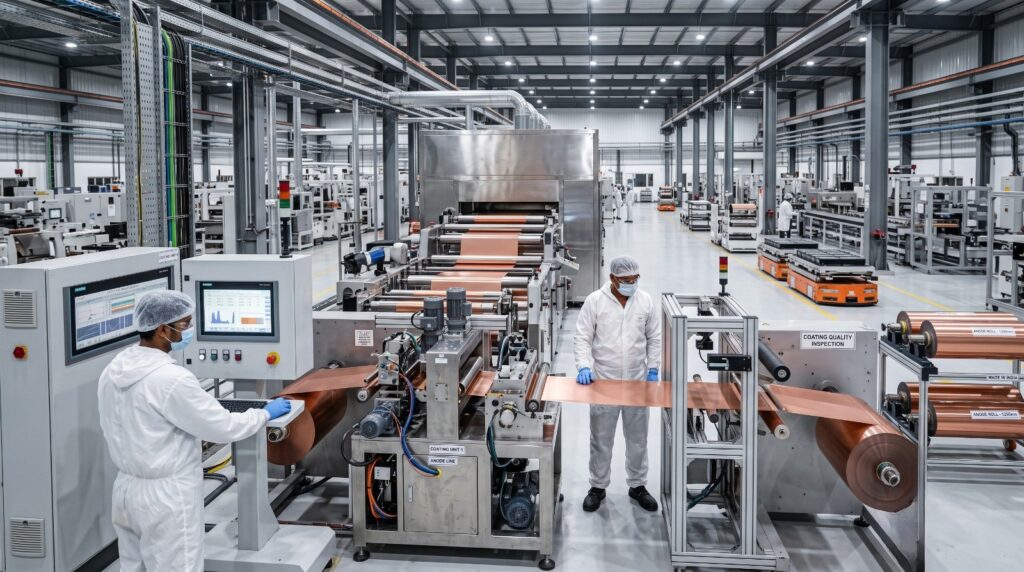
A single battery cell production line involves dozens of specialised pieces of equipment: electrode coating machines, calendering units, slitting machines, winding or stacking equipment, electrolyte filling stations, formation cycling systems, and testing chambers. These are precision instruments. Many weigh multiple tonnes. Some require vibration isolation pads, controlled temperature environments, and specific foundation preparations at the new site.
Equipment arriving from South Korean, Japanese, German, or Chinese manufacturers needs to be received, customs-cleared, transported to the factory site, positioned, levelled, aligned, connected to utilities, and commissioned in a specific sequence. Errors at any stage, an improperly levelled calendering machine or a misaligned winding unit, can affect cell quality for weeks before the root cause is identified.
This is where gigafactory relocation India projects require a very different level of expertise from a standard factory move. The tolerance levels are tighter, the equipment is more expensive, and the cost of a production delay on a commissioned gigafactory runs into crores per day.
5. What Machine and Equipment Relocation Into a Gigafactory Actually Costs
For vendors, component suppliers, and supporting manufacturers setting up facilities near these gigafactory clusters, understanding the physical relocation cost is essential for accurate budgeting.
A single precision production line with 5 to 15 machines typically runs Rs 8 lakh to Rs 40 lakh for full execution including transport and recommissioning, over a 2 to 6 week timeline. For international equipment arriving from South Korea or Germany, add 60 to 150 percent over domestic equivalent costs, depending on freight mode and customs complexity.
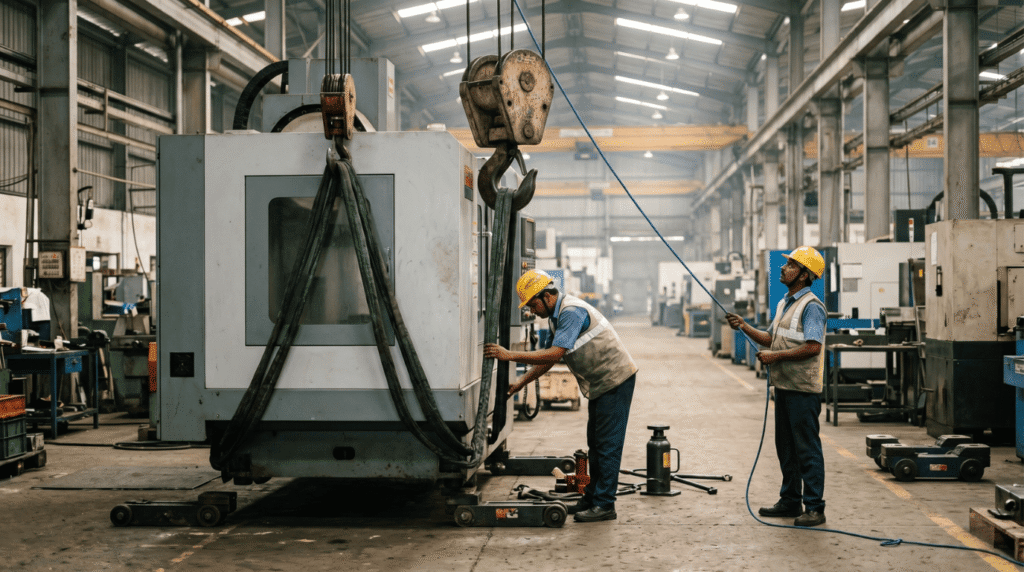
Medium plant setups covering 40 to 100 machines typically run Rs 60 lakh to Rs 2 crore over 2 to 5 months. Large plant relocations above 100 machines are project-specific but commonly range from Rs 1.5 crore to Rs 8 crore and above. Crane hire for heavy equipment in India runs Rs 15,000 to Rs 80,000 per day for smaller cranes and Rs 1 lakh to Rs 4 lakh per day for large hydraulic cranes, which battery production equipment frequently requires.
These are not costs to estimate after the fact. They need to be in the project budget before the first equipment order is placed.
6. The Honest Gaps: What India Still Needs to Fix
A genuinely useful guide on gigafactory relocation India cannot skip the constraints, because they are real and they affect planning.
Despite India targeting 50 GWh of battery manufacturing capacity by end of 2025, actual operational capacity stands at only about 1.4 GWh, representing just 2.8 percent of the target, indicating significant delays in project progress. The PLI-ACC scheme, which had Rs 18,100 crore earmarked for promoting 50 GWh of local cell manufacturing capacity, had disbursed nothing as of early 2026, since none of its 2024 milestones were achieved.
Supply chain depth remains the core structural challenge. Reliance has shifted its near-term focus from manufacturing battery cells from scratch to assembling Battery Energy Storage Systems, and is now in talks with CATL and other global suppliers to procure components, indicating deeper dependence on Chinese supply chains rather than independence from them.
Skilled labour for precision battery manufacturing, raw material security for lithium, cobalt, and nickel, and technology transfer bottlenecks are all real constraints that affect commissioning timelines. Any company planning a gigafactory relocation India project should build 20 to 30 percent timeline buffers into their project plan.
7. What Manufacturers and Vendors Must Do Before This Window Closes
The gigafactory clusters in Gujarat, Tamil Nadu, and Telangana are creating an ecosystem of opportunity around them. Component suppliers, equipment vendors, packaging companies, and logistics partners that position themselves near these clusters in the next 12 to 24 months will have a structural advantage for years.
If your business is planning to set up or relocate a facility to support a gigafactory in any of these corridors, start your site assessment and machine relocation planning now. The construction phase is when equipment goes in. Once a gigafactory is operational, the window for nearby supplier positioning becomes more competitive and more expensive.
Get a proper machine audit done on your existing equipment before requesting relocation quotes. Equipment age, weight, foundation requirements, and recommissioning scope all determine final cost, and surprises mid-project are always more expensive than ones caught during planning.
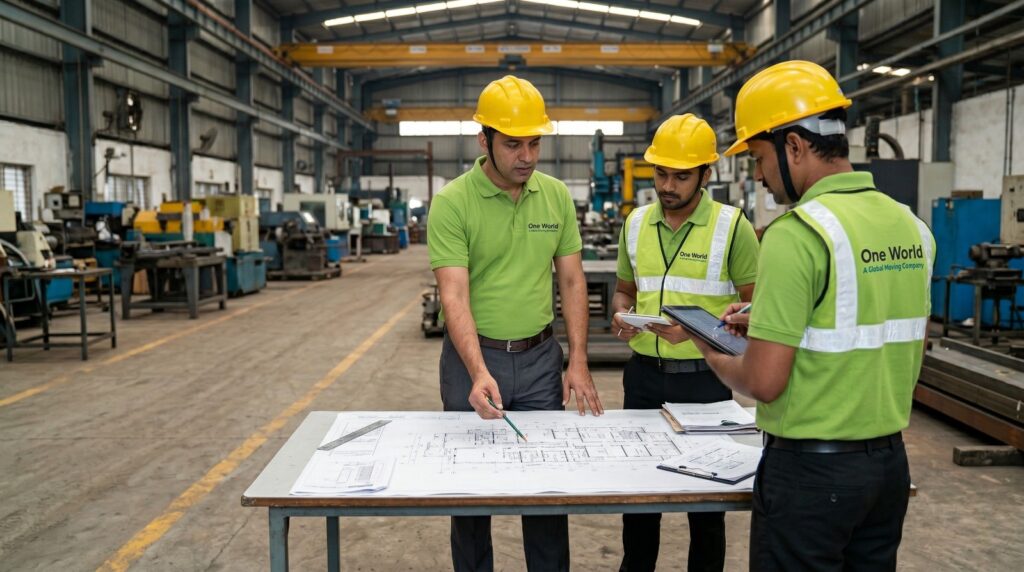
8. How One World Logix Supports Gigafactory Relocation India Projects
One World Logix (OWL), headquartered in CBD Belapur, Navi Mumbai, brings 14 years of machine shifting, factory relocation, and cross-border freight experience to exactly the kind of projects that India’s gigafactory boom is now generating. As India’s Zero-Downtime Migration Specialists, OWL handles everything from single precision machine relocations to full production line setups, including international equipment arriving from South Korea, Germany, or Japan.
OWL holds ISO 9001:2015 certification and is a member of IAM and GEM, the international standards bodies for migration. OWL has handled relocations across 9 industrial sectors including automotive, electronics, pharma, and energy, with in-house mechanical and electrical engineers who manage dismantling, transport, foundation preparation, and recommissioning directly.
Every gigafactory relocation India project OWL handles is quoted on a transparent, line-item basis: assessment, packing, crane hire, transport, reinstallation, and commissioning support all visible separately with no mid-project surprises.
If your organisation is setting up near a battery cluster or relocating equipment into a new gigafactory-supporting facility, start with a free on-site assessment. No commitment, no cost.
Contact One World Logix today:
Phone: +91-88288 20887
Email: info@oneworldlogix.com
Website: oneworldlogix.com/owl/
Book your free gigafactory relocation site assessment. India’s battery boom is being built right now. Make sure your move is planned, not rushed.